
E-Bike Spare Parts and After-Sales Planning for Dealers and Importers
A repair can stall while a workshop tries to identify the correct display, waits for a claim decision or discovers that freight was outside the parts warranty. A dealer’s after-sales plan connects those steps: the vehicle version, diagnosis, replacement part, repair responsibility and customer update.
The stock list follows from that work. Tyres and brake pads may have a local supply route, while a controller or folding assembly may depend on a particular model revision. A practical first-order discussion covers both the parts and the people who will use them.
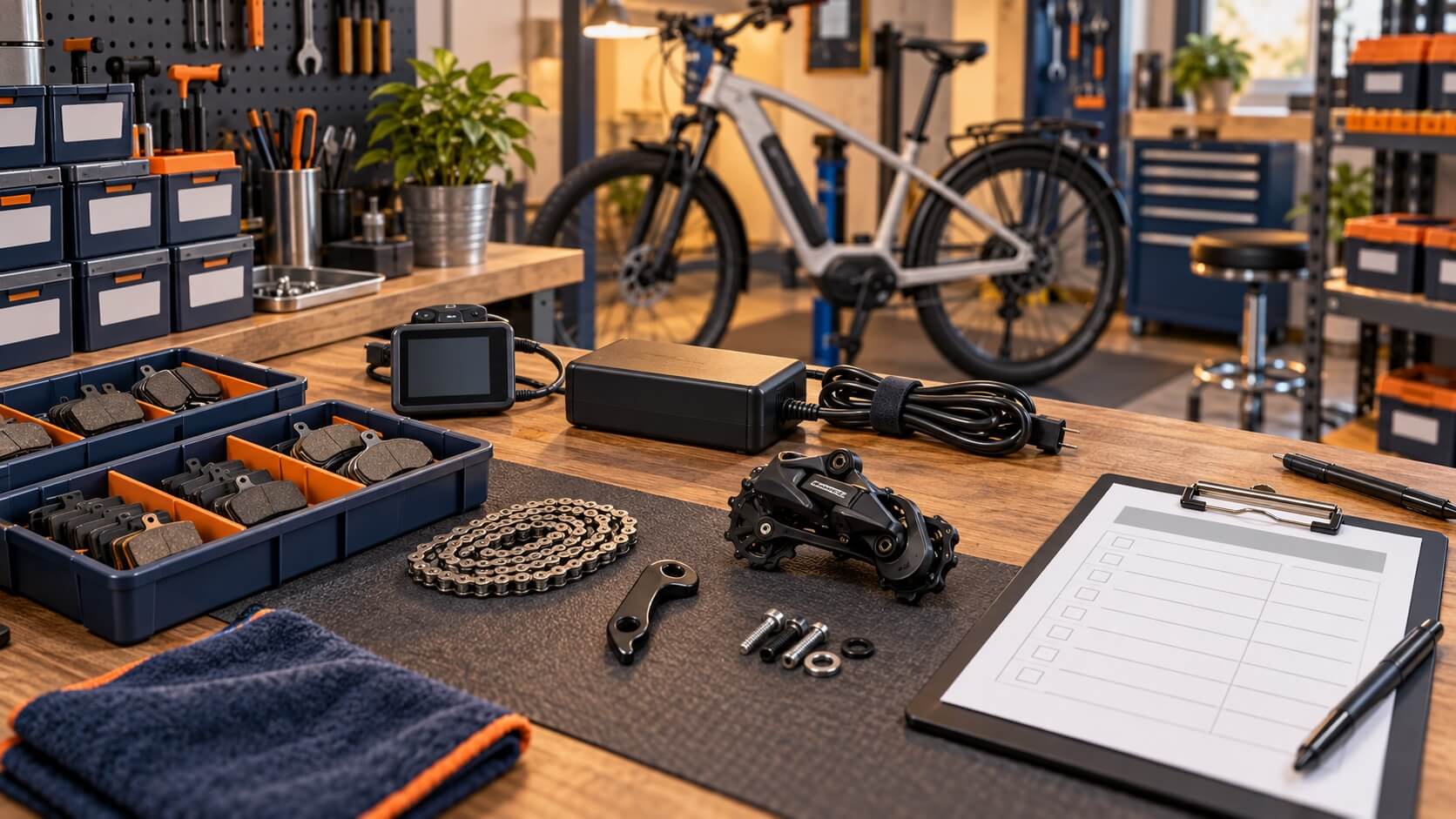
The workshop and supplier each have a role
A retailer may receive the customer’s report, a local workshop may carry out the repair, and an importer may coordinate with the supplier. Those roles can belong to one business or several. What matters is that the customer has a clear contact and the service team knows who can approve the next step.
The local workshop’s capabilities shape the support plan. Bicycle maintenance, electrical fault diagnosis and battery work involve different tools and permissions. A technician who can replace a tyre may still need model-specific information or authorised equipment to diagnose a controller fault.
Ask for the delivered configuration, part identifiers, service instructions, assembly references where available and a technical escalation contact. Confirm any hardware, training, licence or account needed to use diagnostic tools.
The supplier’s response can identify which information and support are available for the proposed order, which work remains with the local workshop and what needs further agreement. Our manufacturer procurement guide covers supplier qualification; the service discussion here concerns the models the buyer intends to sell.
Which spare parts belong on the initial list?
On a phone, swipe the tables sideways to read all columns.
| Group | Examples | Identification detail | Service route to discuss |
|---|---|---|---|
| Routine maintenance parts | Tyres, tubes, chains and brake pads where fitted. | Dimensions, markings and the compatible brake or drivetrain reference. | Locally available approved parts or a defined supplier source. |
| Electrical modules | Battery packs, chargers, controllers, displays, wiring and sensors. | Part and revision references, matching components and any software/settings requirements. | Qualified diagnosis, compatible replacement and any setup needed. |
| Model-specific mechanical and body parts | Covers, locks, mounting parts, folding assemblies and other fitted hardware. | Model/drawing revision, attachment details and approved application. | Model-specific supply and installation instructions; alternatives reviewed before use. |
Identify tyres by their sidewall markings and brake pads by the compatible brake reference. The tyre-size guide explains the markings; the maintenance guide covers routine inspection.
Electrical parts need their system context. A display with the same casing or a charger with the same connector can have different operating requirements. The charger compatibility guide covers that match in detail.
A parts register tied to the delivered model
One catalogue name can cover several production revisions or destination builds. Linking the parts list to the accepted configuration lets a service team find the relevant version after the sale. The vehicle serial or batch record provides the route back to that configuration.
For a line covering E1, E3 and K2, keep each model’s electrical and mechanical references separate. E3’s folding assembly also needs its own service-part reference. Ask the supplier to identify approved applications and current availability in its response.
| Field | Record from the order or supplier response | Use during a repair |
|---|---|---|
| Vehicle model and build | Model, destination configuration, batch/serial link and accepted specification revision. | Identifies the vehicles to which the parts list applies. |
| Part number | Supplier identifier and component-maker reference where available. | Gives the replacement request an unambiguous identity. |
| Part version | Hardware revision and any relevant software or settings reference. | Distinguishes similar-looking versions. |
| Name and visual reference | Part/assembly name, labelled photograph or drawing reference. | Helps the workshop locate and identify the item. |
| Approved fit | Compatible vehicle versions, matching parts and installation/setup requirements. | Shows whether a replacement can be used on this vehicle. |
| Stocking basis | Wear or service demand, repair impact and the number of compatible vehicles in service. | Explains why the item and quantity belong in the local stock plan. |
| Replenishment route | Confirmed source, order unit/minimum, availability response and shipping arrangement. | Provides a route to a dated replenishment estimate. |
| Alternative approval | Who approves a substitute, supporting compatibility information and affected versions. | Keeps an unreviewed alternative out of the accepted parts list. |
Parts bins can carry the part reference and revision rather than only a general name such as “controller”. Recording which replacement was fitted to each vehicle also gives the next technician a useful starting point.
Initial stock and replenishment
A new line has little repair history. Its initial parts discussion can start with the delivered models, expected use, locally available compatible parts and the effect of waiting for a repair. Those assumptions can be reviewed against actual service cases once the vehicles are in use.
For an established line, the relevant figures include the compatible vehicles still in service, part demand, usable stock, outstanding orders and the confirmed replenishment interval. A part used across several builds may justify shared stock; one that fits only a small, older batch has a different demand base.
Hypothetical stock check: six units per month × two months = 12 units of expected demand. With five usable units on hand and four already ordered and due before they are needed, the uncovered demand is 12 − 5 − 4 = 3 units before a buffer. Add an agreed buffer and round to the supplier’s order quantity. These are example inputs, not Jimsen failure rates or delivery times.
Battery inventory has additional storage and handling requirements tied to the pack manufacturer’s instructions. A suspected faulty pack remains separate from usable replacement stock and follows the appropriate assessment route. Battery quantities therefore belong to a pack-specific storage and service plan.
A replenishment enquiry can identify the exact reference and revision, quantity, destination and delivery endpoint. Availability is a dated response for that request. It can distinguish parts already available from those awaiting production, without turning a current answer into a permanent stock guarantee.
Warranty coverage and the cost of a completed repair
The supplier’s commercial warranty and the dealer’s service to the end customer involve different relationships. A supplied replacement part may resolve the component cost while leaving diagnosis, installation or freight to be agreed. Local obligations toward customers also depend on the sales market.
Jimsen provides a two-year warranty under the applicable order terms. Confirm the start date, covered components, exclusions and remedy for your order. Diagnosis, repair labour, freight and import charges need their own allocation; a two-year warranty does not make every repair cost free.
| Item | Decision to record | Evidence or commercial detail |
|---|---|---|
| Fault intake | Who receives the customer report and coordinates updates. | Case reference, communication contact and the next agreed step. |
| Diagnosis | Who reviews symptoms and authorises tests or further assessment. | Approved procedures, tools, required information and diagnostic labour treatment. |
| Replacement part | Who approves the remedy and confirms the compatible part. | Coverage decision, part/revision reference and whether a kit or setup is needed. |
| Repair labour | Who performs and pays for the agreed work. | Authorised scope, evidence of completion and any reimbursement basis. |
| Freight and import charges | Who arranges and pays for the relevant journey. | Destination, delivery term, applicable fees and approved route. |
| Failed-part handling | Return, assessment, retention or authorised disposal route. | Instructions for that part; batteries require separate transport assessment. |
| Timing and closure | Agreed response milestones, customer updates and the person who closes the case. | Actual case status and repair verification, with open items retained. |
A waiting-for-diagnosis case and a waiting-for-part case need different updates. The case record can show the current owner and next agreed action without presenting an estimate as a guaranteed completion time.
A useful fault report
A short, specific report helps the service team distinguish a symptom from its cause. “Display stays dark after the usual start procedure” describes an observation. “The controller is broken” assumes a diagnosis. The technician’s assessment can be added after the vehicle and system are identified.
| Field | Information to capture | Purpose |
|---|---|---|
| Case and vehicle identity | Case reference, model, serial/batch and configuration version. | Links the report to the delivered vehicle and parts list. |
| Purchase or delivery record | Relevant date and order/invoice reference. | Supports review against the agreed commercial terms. |
| Observed symptom | What happened, when it occurs and relevant operating circumstances. | Describes the fault without guessing the failed component. |
| Code or message | Exact displayed code or wording, if present. | Preserves information for the model-specific diagnostic process. |
| Photos or video | Relevant labels, affected area and a symptom recording where safe. | Helps identification without repeating a hazardous event. |
| Safety and checks | Reported safety concern, vehicle-use status and permitted checks already completed, including who performed them. | Shows whether the case needs safety escalation or further authorised assessment. |
| Assessment and decision | Technician findings, coverage decision, approved work and replacement reference. | Separates the technical finding from the commercial remedy. |
| Repair and closure | Work performed, fitted part/revision, final check, customer update and unresolved items. | Records what resolved the case and what remains open. |
The report can omit personal information unrelated to the fault. Shared examples can remove customer names, contact details, payment information and commercially sensitive order data. A workshop’s evidence request should not ask a rider to reproduce overheating, open a battery pack or bypass a protection system.
For a dark display, the e-bike start-up troubleshooting guide covers basic checks and escalation. Detailed work still follows the selected system’s service instructions and the technician’s authorised scope.
From the report to a completed repair
The retailer, importer and supplier can agree who handles each stage and which record passes to the next person. The order terms set coverage and timing; the workflow keeps the case moving through assessment, repair and closure.
| Stage | Responsible role to agree | Result retained in the case |
|---|---|---|
| 1. Receive and assess urgency | Customer-facing retailer or importer, with qualified safety escalation where needed. | Case reference, vehicle identity, symptoms and the appropriate use/assessment status. |
| 2. Review the fault | Authorised workshop or technical reviewer. | Findings from permitted checks and any further evidence needed. |
| 3. Agree the remedy | The party authorised by the commercial terms to make the coverage decision. | Approved work, costs/responsibilities and the compatible replacement reference. |
| 4. Arrange the part | Parts coordinator and the agreed supplier/logistics contacts. | Dated availability and dispatch information, destination and failed-part instructions. |
| 5. Complete and verify the repair | Authorised technician. | Work record, fitted version and relevant post-repair checks under the service procedure. |
| 6. Update and close | The customer-facing case owner. | Customer communication, completion status and any issue requiring further work. |
Review closed cases by delay reason: wrong part identification, unresolved diagnosis or late replenishment. Use the findings to adjust the parts register, technician instructions or stock plan.
Battery returns need a separate route
A damaged or suspected defective lithium battery is not an ordinary parcel return. The US transport regulator PHMSA explains the greater transport risks associated with damaged, defective or recalled batteries and the applicable US shipping requirements.
The case needs review by the responsible battery specialist and a suitable dangerous-goods transport or disposal provider before a return is booked. Destination rules, carrier acceptance, pack condition and the proposed route affect the arrangement. The battery shipping-document guide provides related background; documents for an original shipment do not by themselves establish a damaged-pack return route.
The outcome may be an approved assessment, transport or local treatment arrangement for that case. A supplier’s parts warranty alone does not establish which route is available or who pays for it.
Replacements, substitutions and discontinued parts
A substitute can affect more than the part on the shelf. It may need a matching component, different settings or revised instructions. A change record can identify the old and new references, the affected vehicle versions, compatibility information, installation requirements and who approved the change.
If a component is discontinued, the discussion concerns remaining supply, any approved alternative or conversion, and the builds affected. Actual availability and notice arrangements belong in the commercial record. A general promise to find a similar item leaves those questions open.
For OEM orders, the parts register can follow the accepted sample and production configuration through the manufacturing process. Changes made after sampling can then be reflected in service information for the delivered vehicles. Sample and production timing are covered separately in the MOQ and sample guide.
Discussing a model-specific parts plan with Jimsen
The electric bike range and electric moped range identify the candidate platforms. A service enquiry can add the destination, selected models and configuration versions, order scale or compatible vehicles already in use, and the local workshop arrangement. Existing repair records, if available, help explain which parts deserve attention.
Jimsen’s OEM/ODM route provides a place to discuss those requirements alongside the order. The requested response can cover proposed parts references, available service information, open compatibility questions and the warranty, supply and replenishment terms that need agreement for the project.