
How to Choose a Folding E-Bike: Folded Size, Weight and Daily Use
Choose a folding e-bike by testing the job it must do off the road as well as on it. Measure the storage opening, check the complete carrying weight and practise the fold, lift or roll before buying. Then confirm rider fit, permitted load, gearing and repair support. A bicycle that folds is not necessarily light, easy to carry or allowed on your train.
This guide helps you compare specifications and demonstrations. It is not a tested “best folding bikes” ranking. Model examples are identified so that you can distinguish a manufacturer’s documented feature from a general design assumption.
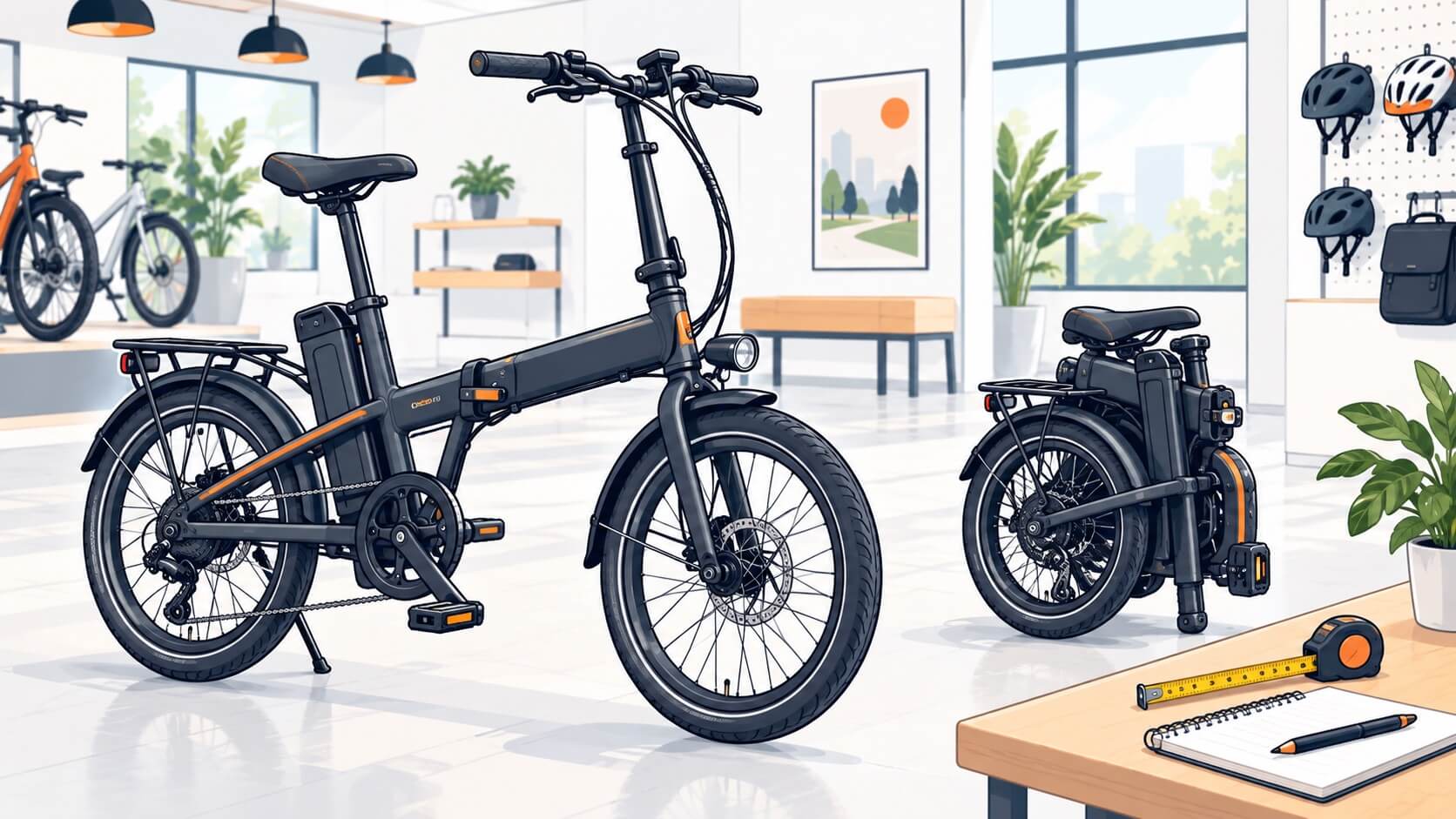
Define the fold you actually need
A commuter taking a bike through a station several times a day has a different problem from a motorhome owner folding it once per trip. Write down the tightest point: an office cupboard, luggage area, car opening, staircase or lift. Include how far you must carry the bicycle, not just the distance you ride.
| Your main task | Decisive demonstration | Common buying mistake |
|---|---|---|
| Daily public transport | Fold and secure the bike, then move it the required distance | Assuming a folding label overrides the operator’s e-bike or battery policy |
| Small home or office | Pass through the opening and park without blocking access | Measuring floor area but ignoring height, door swing or removal space |
| Car or motorhome | Load the bike through the actual opening, without unsafe lifting | Comparing folded volume with boot volume instead of checking shape |
| Occasional storage | Check stability, cables and the reopening procedure | Accepting a difficult daily ride for a fold you rarely use |
Compare three dimensions, not a single “compact” claim
Record folded length, width and height in the orientation the manufacturer specifies. Note whether those figures require a removed battery, folded pedals, lowered seatpost or detached accessory. A basket or child seat may change the fold. Ask for measurements of the configuration you plan to buy.
A simple cardboard outline can reject an obviously unsuitable storage space before a test visit. Suppose, as an illustration, a cupboard opening is 80 cm wide and a folded bike is quoted as 85 cm long. Its remaining dimensions and allowed orientation might let it pass through, or the door and turning space might prevent it. Volume alone cannot answer that. Try the real bicycle or a three-dimensional mock-up before relying on a diagonal fit.
Leave practical clearance for fingers, handles and daily movement. This is not an instruction to store a battery in a sealed cupboard: charging and fire-safety conditions require a separate assessment. A compact footprint does not establish a safe charging location.
Separate total weight from what you must lift
Read the footnote beside every weight figure. Does it include the battery, pedals, rack and bags? Can the battery be removed without tools, and where will you put it while carrying the rest? Two separate loads may be easier to manage, but they still need secure handling.
The current Brompton Electric C Line page, checked on 21 September 2026, lists weights from 17.3 kg including the battery and from 13.8 kg without it. Those are “from” figures for that range, not a measurement of every configuration or a recommendation that you lift that amount. Do not use a non-electric C Line specification or an older system’s weight for the current model.
In a shop, practise the actual movement with assistance available. Check balance, gripping points and whether folded parts remain secured. If you cannot control the load, choose another storage arrangement or model. Do not improvise by lifting from cables, the battery handle or a part not intended as a carrying point.
Rolling and upright parking are model-specific features
Small transport wheels, a stable folded position or a rack that supports vertical parking can make daily use easier. Ask the dealer to demonstrate these functions rather than assuming all folders share them.
Tern’s Vektron Gen 4 Bosch eBike System 2 guide describes rolling the folded bicycle and parking it on the rack ends. It specifies a flat surface and a completely folded bicycle for vertical parking. These are instructions for that Vektron generation, not permission to balance another e-bike on its rear rack.
During the demonstration, look for rubbing cables, exposed connectors, parts that drag on the floor and an awkward latch. Ask who services the hinge and which checks the manual requires. Difficulty locking a hinge is a reason to stop and ask for help, not to apply more force or alter its adjustment yourself.
Confirm rider fit and load before comparing motor headlines
Small wheels do not make a folding e-bike a children’s bicycle. Fit depends on the frame, seatpost and cockpit adjustment. Each rider must be able to pedal, reach the brakes and control stops within the manufacturer’s adjustment limits. “One size” means one manufactured frame size, not a guarantee that it suits every person.
Load terminology also varies. Tern’s guide gives that Vektron a maximum gross vehicle weight of 125 kg, including the bicycle, accessories, rider and cargo. A retailer calling such a figure “rider capacity” would change its meaning. Record the definition beside the number, and check any lower rack or accessory limit separately.
Try the bike on a permitted route that resembles your use. Ask about low gearing for starts and hills, the assistance behaviour and braking control. Do not judge hill suitability from motor wattage alone; our motor-wattage guide explains the limits of that number.
Wheel size, comfort and replacement parts
A smaller wheel can support a compact fold, but tyre construction, pressure, geometry and suspension also affect how a bicycle feels. Test the bike on representative surfaces within its intended-use category. A broad “all-terrain” phrase does not establish permission for jumps or rough trails.
Write down the tyre’s ETRTO size and valve type, then check whether local shops stock compatible tyres and tubes. Nominal inch labels can be ambiguous; our tyre-size explanation helps you identify the relevant markings. Proprietary folding parts, electrical components and batteries need their own supply route.
Ask the seller to name the workshop that handles electrical diagnosis and hinge service. Obtain the battery and charger part numbers and the model-year compatibility information. A standard-looking connector is not proof that a generic replacement battery is safe or compatible.
Check transport rules before buying for a commute
Consult the actual operator’s current bicycle and lithium-battery policies for your route. A company can distinguish folded bicycles from folded electric bicycles, or impose peak-time, packaging or battery conditions. Do not infer permission from another operator’s rules or from a seller saying the bike is “train friendly”.
For a car journey, check loading and restraint as a separate task. A folded bicycle can move inside a vehicle during braking. Follow the vehicle and bicycle instructions for transport; do not treat the folded latch as a cargo restraint. Confirm safe handling of a removable battery before travel.
The comparison sheet to complete at the shop
- Exact model, year and market version.
- Folded dimensions with the accessories you will use.
- Complete weight, removable parts and approved carrying points.
- Rider fit range, usable adjustment limits and defined total load.
- Hinge locking check, rolling/parking method and maintenance instructions.
- Battery/charger part numbers and named service provider.
- Transport permission and a successful storage/loading demonstration.
After purchase, add the manufacturer’s hinge and latch checks to your regular e-bike inspection routine. Stop riding if a joint will not secure correctly or develops unexplained movement.
Questions buyers ask
Is the lightest folder always the best?
No. It must also fit the rider, support the intended load and have suitable gearing, brakes and parts support. Compare carrying weight only after those requirements are met.
Does folded size tell me whether it fits my car?
It gives a starting envelope. Opening shape, wheel arches, orientation and lifting clearance can still prevent loading. Test the actual car and bicycle together.
Can I store any folder upright?
Only when the manufacturer supports that position and the bicycle rests as instructed. A rack designed to carry luggage is not automatically a parking stand.
What should a dealer ask an OEM supplier?
Provide the target riders, required folded envelope, carrying task, local transport rules and expected load through Jimsen’s OEM/ODM project enquiry. Request a proposed configuration and sample demonstration covering the fold, locking, handling and service-parts requirements. Do not approve a model from a folded-size drawing alone.