
Can You Ride an E-Bike in the Rain? What Is Safe, What Is Not
You can ride an e-bike in rain when the exact bike’s instructions permit it, its electrical covers and seals are intact, and the route is safe. That does not make the bike suitable for flooding, immersion, pressure washing or months of outdoor storage. A motor’s water-resistance rating also does not describe the battery, display, wiring or complete bicycle. Check the whole-bike instructions before relying on a component rating.
A shower on the way home, weeks parked outside and a flooded road expose the bike to water in different ways. A bike approved for rain riding may still be unsuitable for the other two.
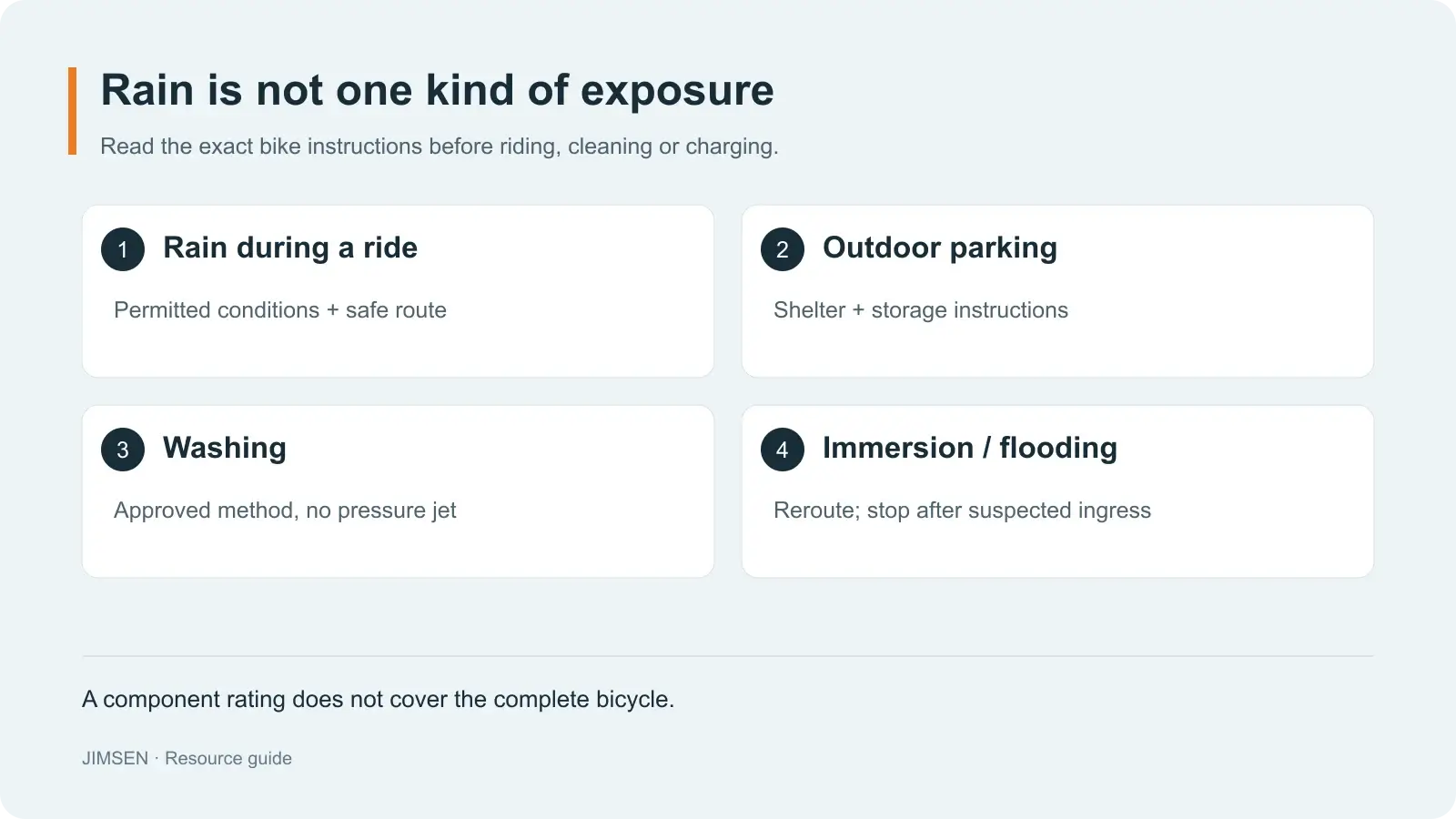
Check your model’s water-resistance instructions
Find the model and model year, then read the riding, cleaning, battery and storage instructions. Look for a statement covering the complete bike and note any separate limits for the battery, motor and display. The same brand can use different protection levels on different models.
For the mid-drive bikes covered by Aventon’s water-resistance guidance, Aventon lists the motor as IP67 and the complete bike as IPX6. These ratings apply to different objects. Follow the complete-bike instructions for riding, washing and storage; Aventon excludes submersion and long-term outdoor storage.
An IP rating describes protection under specified test conditions. It is not a warranty against every form of water damage. An “X” in a rating such as IPX4 does not give a dust rating. Damaged covers, missing port caps, altered wiring and deteriorated seals can also change the condition of a used bike.
Rain, parking, puddles and washing: decide by exposure
| Exposure | Check | Where to look | When to stop |
|---|---|---|---|
| Rain during a ride | The exact model permits the conditions; covers are closed; braking and visibility remain adequate | Vehicle manual and model-specific water guidance | Stop in a safe place for electrical faults, abnormal braking or unsafe visibility |
| Road spray | Battery mounting, cables and port covers are intact; no known damage | Inspection instructions and applicable protection statement | Do not continue repeated tests with an intermittent display or power loss |
| Repeated outdoor parking | Shelter, permitted storage conditions and protection of exposed contacts | Storage section and warranty exclusions | Move to suitable shelter; assess corrosion or suspected ingress before charging |
| Standing water or flooding | Hidden depth, current, road damage and immersion risk | Route conditions; immersion restrictions in the manual | Choose another route. A rain rating is not permission to cross floodwater |
| Washing | Approved method, battery-removal procedure and areas that must not receive water | Cleaning instructions | Stop if water may have entered an electrical enclosure; obtain model-specific service advice |
A sheltered bike can still encounter damp air, condensation or salt carried in road spray. Shelter reduces exposure; it does not replace inspection. A waterproof cover is also not an instruction to store a wet battery in an unsuitable location.
Before a wet-weather ride
Check the charge-port cap, battery seating and lock, visible cable damage and any covers identified in the manual. Do not open electrical housings to inspect their seals. A missing cover or a loose battery is a reason to resolve the problem before setting out.
Check tires and brakes as you would for any ride, with more attention to wet conditions. Tire pressure should remain within the tire, rim and vehicle requirements; do not apply a universal rain-pressure reduction. Our e-bike tire pressure guide explains how load and tire size affect that decision.
Use functioning lights and allow more room to slow down. Wet paint, metal covers, leaves and other slippery surfaces deserve particular care. Reduce speed before a turn rather than assuming electrical assistance will make the bicycle stable. Tern’s operating manual treats wet-weather riding as a traction and braking issue as well as an equipment issue.
Reroute around flooding. Water can conceal a pothole or other obstacle even when it does not reach an electrical component. A component’s height above the road is not a safe depth limit.
After riding: inspect before charging
- Switch off according to the manual and bring the bike to suitable shelter.
- Remove surface moisture with the permitted cleaning method. Follow the battery-removal instructions if removal is needed; do not handle damaged electrical connections.
- Inspect accessible charging connections for moisture, dirt or damage before connecting the approved charger.
- Check for an error code, unexpected shutdown, unusual heat, damaged enclosure or a changed braking response.
- Clean the drivetrain as needed and keep cleaners or lubricants away from braking surfaces.
Surface drying and internal drying are different. A case that looks dry does not prove the inside is dry after immersion or suspected ingress. There is no universal “wait 24 hours” rule that makes a wet or damaged battery safe to charge.
Do not use charging as a diagnostic test. If the battery was submerged, its casing is damaged or an electrical fault appeared after water exposure, stop use and charging and follow the manufacturer’s service process. Do not open the pack, apply a hair dryer or bypass protection. The FDNY battery-safety sheet identifies overheating, unusual smells, shape or colour changes, leaks and unusual noises as reasons to stop using a battery. If it smokes or catches fire, leave the area and contact local emergency services. Do not try to carry an actively failing battery.
The CPSC micromobility safety guidance recommends the supplied or manufacturer-recommended charger and being present while charging. For routine washing rather than suspected damage, use our e-bike cleaning guide.
Can you leave an e-bike in the rain?
Brief parking permitted by the manual is not the same as repeated, long-term exposure. Outdoors, water can collect around joints, electrical contacts and accessories, while dirt and corrosion can develop between rides. Use storage suitable for the complete bike, not merely a cover over the saddle.
If the battery is removable, removal may help with storage only when the manual permits the procedure and the pack can be stored safely. It can also expose contacts on the bike; protect them using the manufacturer’s method rather than improvised tape or a bag over live connections. Battery storage temperature and charge-state instructions remain pack-specific. See how to store an e-bike battery for the separate storage task.
If the bike develops a fault after rain
Record the bike model, battery and charger identification, the approximate exposure, the time the symptom began and the displayed error. Photographs of an accessible damaged cap, loose mounting or visible moisture are useful if they can be taken safely. State whether the problem appeared while riding, after parking or at the start of charging.
That information helps distinguish a wet connector from an unrelated brake, drivetrain or battery problem. Do not keep reproducing a shutdown to obtain a video. The dead-display checks and charging diagnostic guide provide separate, external checks; suspected ingress takes priority over those routine checks.
Dealers and importers: specify the wet-weather use
A useful supplier request says where the bikes will operate, how often rain is expected, whether roads are salted, where customers will park and how the bikes will be cleaned. “Waterproof e-bike” is too vague to define an acceptance requirement.
Ask for the proposed model’s riding, cleaning, charging and storage instructions, plus its water-damage warranty terms. If the supplier quotes an IP rating, find out which part was tested and which battery and electrical configuration the result covers.
For a Jimsen project, send the target market, model shortlist, wet-weather use and parking arrangement and ask for candidate platforms, configuration questions that remain unresolved, the instructions and supporting documents available, and the checks the sample should undergo before selection. See the OEM/ODM page for customisation options.
Questions about rain and e-bikes
Are e-bikes waterproof?
Not as a general category. Use the exact model’s protection statement and instructions. A component rating does not establish protection for the complete bike.
Can an e-bike battery get wet?
A pack may tolerate the water exposure specified for its installed use. That does not approve immersion, charging with wet connections or continued use after suspected ingress.
Can I ride in heavy rain?
Only within the bike’s instructions and safe route conditions. If visibility, traction, braking or flooding makes the route unsafe, choose another form of transport even if the electrical system permits rain.
Does wrapping the battery make a bike waterproof?
No. A wrap does not establish protection for the whole vehicle and may interfere with mounting, ventilation or drainage. Use only accessories approved for that model and purpose.
Should I charge immediately after a wet ride?
Inspect the permitted charging points and follow the manual. Do not charge if moisture, damage or suspected ingress remains. A fixed waiting time is not a safety test.
Do I need to lubricate the chain after rain?
Inspect and clean according to the drivetrain instructions, then lubricate if required. Chain care covers the method; belt-drive instructions differ.