
Fat-Tire vs Regular-Tire E-Bikes: Choose for Your Route, Not the Look
Choose a fat-tire e-bike when the complete bicycle suits the soft or uneven surfaces you actually ride and you can manage its size, transport and replacement parts. For mostly paved journeys, compare it with a city or trekking e-bike before paying for extra tire width. Width alone cannot tell you which bike has more grip, travels farther or feels more comfortable. Tire construction, tread, approved pressure, wheel size and the rest of the bicycle all matter.
This guide compares complete-bike purchase choices. It does not recommend fitting oversized tires to an existing bicycle or claim that Jimsen has tested a universal range difference.
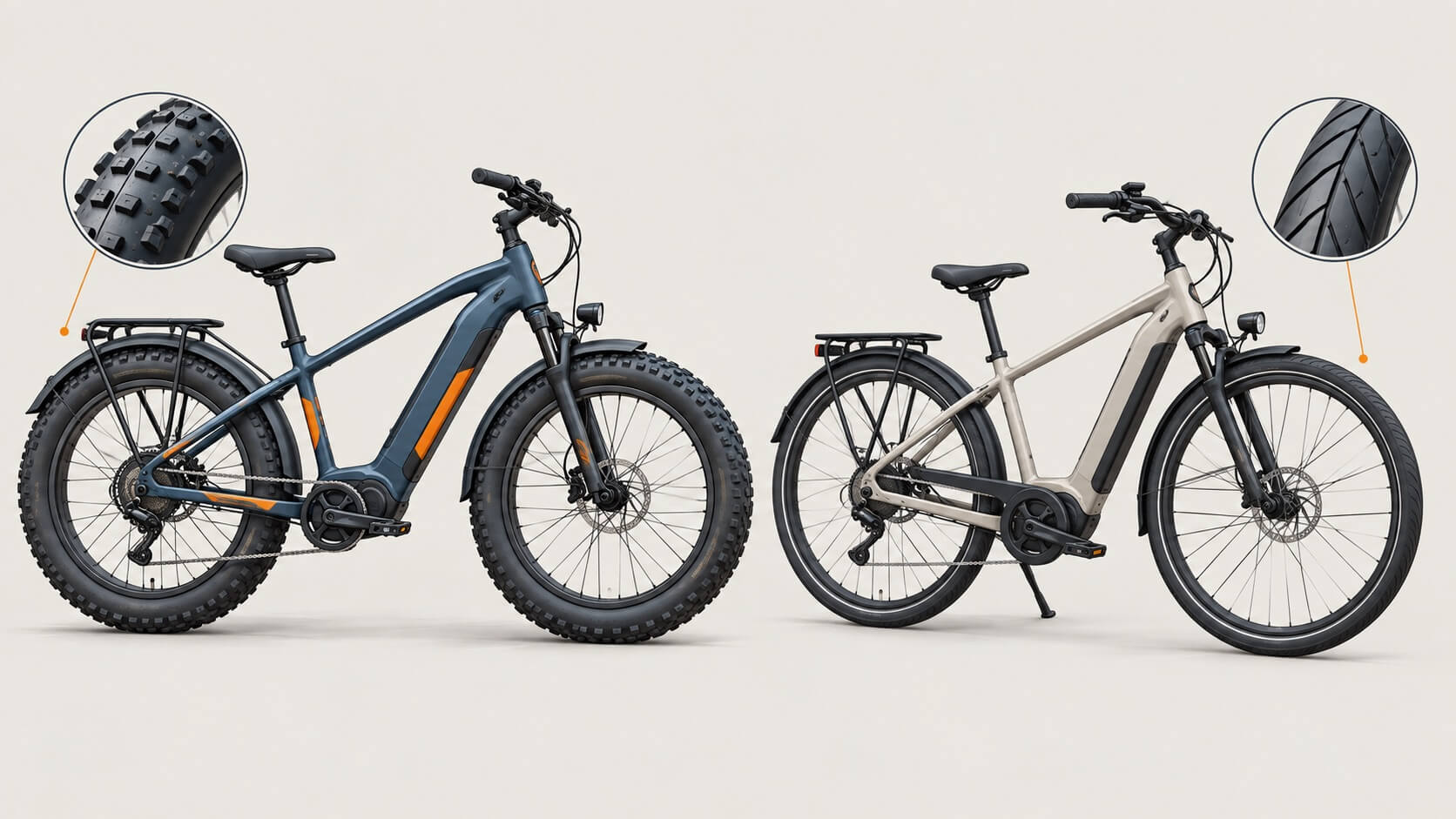
Separate width from the other tire specifications
“Regular tire” is not a precise technical size. A narrow road tire, a wider urban tire and a mountain-bike tire can all sit outside a seller’s fat-tire category. Compare the actual markings and the manufacturer’s intended use rather than deciding from the category name.
| Variable | Question to ask | Misleading shortcut |
|---|---|---|
| Width and wheel diameter | What exact tire and rim are fitted? | Assuming every 20-inch tire fits every 20-inch wheel |
| Tread | Is the pattern intended for the normal riding surface? | Treating large knobs as a guarantee of paved-road grip |
| Casing and protection | What construction and puncture protection does this model use? | Assuming a thick-looking tire cannot puncture |
| Pressure and load | What do the tire, rim and bicycle permit for the actual load? | Using one PSI recommendation for every wide tire |
| Complete bicycle | Can you handle, store and transport it with normal accessories? | Attributing every ride difference to tire width |
Our tire-size and ETRTO guide explains the markings. Use it to establish the dimensions before comparing replacement availability.
Why wider does not automatically mean slower—or faster
Schwalbe’s rolling-resistance explanation identifies pressure, diameter, width, construction and tread as separate influences. Its comparison of wide and narrow tires is conditional on pressure; it also distinguishes smooth surfaces from rough ground. That is not evidence that any fat-tire e-bike will use less energy than any narrow-tire e-bike.
When two complete bicycles differ in motor settings, rider position, mass and tires, a short ride cannot isolate one variable. A seller’s range figure may use different assistance, load and terrain from yours. Request the test conditions, not just the headline kilometres.
For a useful purchase comparison, test the shortlisted bicycles on the same permitted route with the same rider and representative luggage. Have the shop set each bicycle’s pressures correctly; do not force both to the same PSI just to make the comparison look controlled. Record effort, steering, surface harshness and handling at low speed. Treat that as a personal fit test, not a scientific efficiency test.
Match the choice to the journey
Mostly paved commuting
Start with the practical constraints: storage doorway, stairs, parking rack, mudguards and the tires a nearby shop can supply. Compare an appropriately equipped city or trekking bike with the fat-tire option. A dramatic-looking tread is not automatically useful on a smooth commute. Check cornering and stopping confidence on a safe test ride rather than relying on the appearance of the contact patch.
Loose or soft surfaces
Ask whether the complete bicycle is approved for the intended terrain, not merely whether its tires are wide. Identify the actual surface—maintained gravel, deep loose sand and a technical trail are different tasks. Ask a knowledgeable dealer about suitable tire construction and permitted pressure for that application. Extra width does not authorise jumps, steep descents or riding beyond the frame and fork’s intended use.
Mixed routes with broken pavement
Try the roughest representative section within your ability and the bike’s permitted use. Compare control as well as comfort. A bicycle that feels plush in a straight line but is difficult for you to manoeuvre through a narrow turn may not be the better everyday choice. Fit and suspension deserve separate checks; neither should be judged from the tire label.
Do not use a lower pressure as a universal comfort fix
Use the limits for the tire, rim and bicycle, accounting for rider and cargo load. An unsuitable pressure can create a handling or damage problem. Our e-bike tire-pressure guide explains how to establish a permitted starting point and make cautious adjustments. There is deliberately no fat-tire PSI chart here that overrides the component manufacturers.
Recheck pressure with a suitable gauge rather than judging it by squeezing the sidewall. If a bike feels unexpectedly harsh, unstable or difficult to steer, ask the shop to inspect the setup. Do not keep reducing pressure to hide a poor fit, damaged tire or unsuitable configuration.
Check replacement and transport costs before buying
Ask for the exact replacement tire, tube or tubeless service specification, plus a local parts-and-labour quote. Record whether the shop normally stocks it or must order it. A common label such as “fat tire” is not a parts number. If the rear wheel contains a hub motor, ask whether the workshop services that system and what a wheel-removal job involves.
Check the bicycle’s ready-to-transport weight and the car rack’s individual-bike limit, tire-tray width and fastening compatibility. A rack rated for the total weight can still be unsuitable for a particular tire width or wheelbase. Ask for a fit demonstration with the exact rack; do not use improvised straps as a substitute for compatibility.
For storage, measure the handlebars as well as the tires. The widest part of the bicycle may not be the wheel. Practise moving the bike with assistance off and its normal luggage fitted. If you need to lift it regularly, test that requirement before ordering.
A short comparison sheet for two candidate bikes
- Write down your normal route and the occasional surface that is genuinely necessary.
- Record tire model, size, complete-bike weight, permitted load and intended use for both candidates.
- Get each bicycle set up appropriately and try the same safe route.
- Obtain a replacement-tire quote and confirm a workshop can service the rear wheel.
- Check the home and transport fit. Reject a candidate that fails a necessary daily task.
Keep a photo of the installed tire markings after purchase. Use the tire-wear inspection guide when checking condition; width does not establish remaining life.
Common questions
Do fat tires always reduce e-bike range?
No universal percentage is supported here. Compare the complete configuration and the conditions behind a range claim. Width, construction, tread and pressure cannot be treated as one variable.
Can I fit fat tires to my current e-bike?
Not without checking compatibility. Schwalbe’s dimension guidance requires matching tire diameter and rim dimensions and checking the available frame space. The bicycle and fork limits also apply. Have the manufacturer or a qualified shop assess the proposed change.
Are fat tires puncture-proof?
No. Inspect the exact tire’s condition and construction and maintain the correct setup. Do not infer protection from width or marketing photographs.
What is the next step if both types seem suitable?
Book a side-by-side test ride and bring your storage measurements and normal load. Choose the bike that passes those checks with a workable service route, not the one with the most persuasive category label.