
6 E-Bike Brands in New Zealand: Prices, Strengths and Trade-Offs
For a low-step NZ commuter, compare Wattwheels Oxford LS V3 with Sinch Jaunt EZ 2.5 first: Oxford has the lower displayed price, while Sinch offers a removable Shimano battery and a different drivetrain. Oxford’s 120 kg combined bike/rider/cargo limit can rule it out before price matters. Smartmotion, Giant, MeloYelo and Trek add other riding categories and buying routes. This six-brand guide separates NZ-founded businesses from overseas brands sold locally and uses dated manufacturer facts, not a reliability ranking.
Six-brand comparison · Model prices · Oxford versus Sinch · NZ classification
Choose by rider load, transport and how soon you need the bike
Town commuting with a budget near NZ$4,000
The Oxford LS V3 lists NZ$3,999 with 500 Wh, or a 672 Wh upgrade at an extra NZ$299. The listed upgraded subtotal is therefore NZ$4,298 before any unlisted charges. Sinch Jaunt EZ 2.5 lists NZ$5,999.99 with 630 Wh: NZ$1,701.99 more than that upgraded Oxford example. The dearer bike does not have the larger listed battery in this comparison. Compare fit, drivetrain and the handover package to decide whether its premium solves a problem for you. Prices and these specifications were rechecked on 8 October 2026; no matched range test is available.
A heavier rider or a loaded everyday trip
Oxford’s manufacturer specifies a 120 kg combined bicycle, rider and cargo limit and a 26–27 kg bicycle. That leaves roughly 93–94 kg for rider and cargo, before uncounted additions. A hypothetical 95 kg rider already takes the total to 121–122 kg without luggage, so this Oxford example should be excluded for that rider. A larger battery does not solve the load-limit failure. Sinch’s load allowance has not been established in this comparison, so it is not an automatically approved substitute.
Motorhome travel or frequent car-rack loading
Oxford’s listed 26–27 kg includes its battery. Sinch lists 28.8 kg total weight. Both deserve a carrier-limit and loading-method check before purchase; neither is a lightweight lifting recommendation. If the complete arrangement exceeds your rack’s allowance or you cannot load it safely, rule it out before comparing torque. Battery removal can change the lifted item, but each manufacturer’s stated procedure and the rack’s limits still apply.
You depend on one bike and live far from a workshop
Sinch documents collection through an authorised Experience Centre after assembly. Wattwheels publishes regional stockists; MeloYelo uses regional agents. That gives you different service routes to compare, not a nationwide service-speed ranking. Prefer the candidate with an identified repair route you can reach with a non-ridable bicycle. A demonstration agent without an established repair handover is insufficient for a daily-transport decision.
Original model-price examples checked 21 September 2026; MeloYelo and Trek brand/channel entries checked 29 September 2026. This is a source-based buying shortlist, not a road-test ranking or a complete list of NZ brands. Jimsen manufactures electric two-wheelers; brand inclusion is based on publicly verifiable information and does not indicate a commercial relationship or endorsement. Prices below are dated NZD website observations, not quotations or stock guarantees.
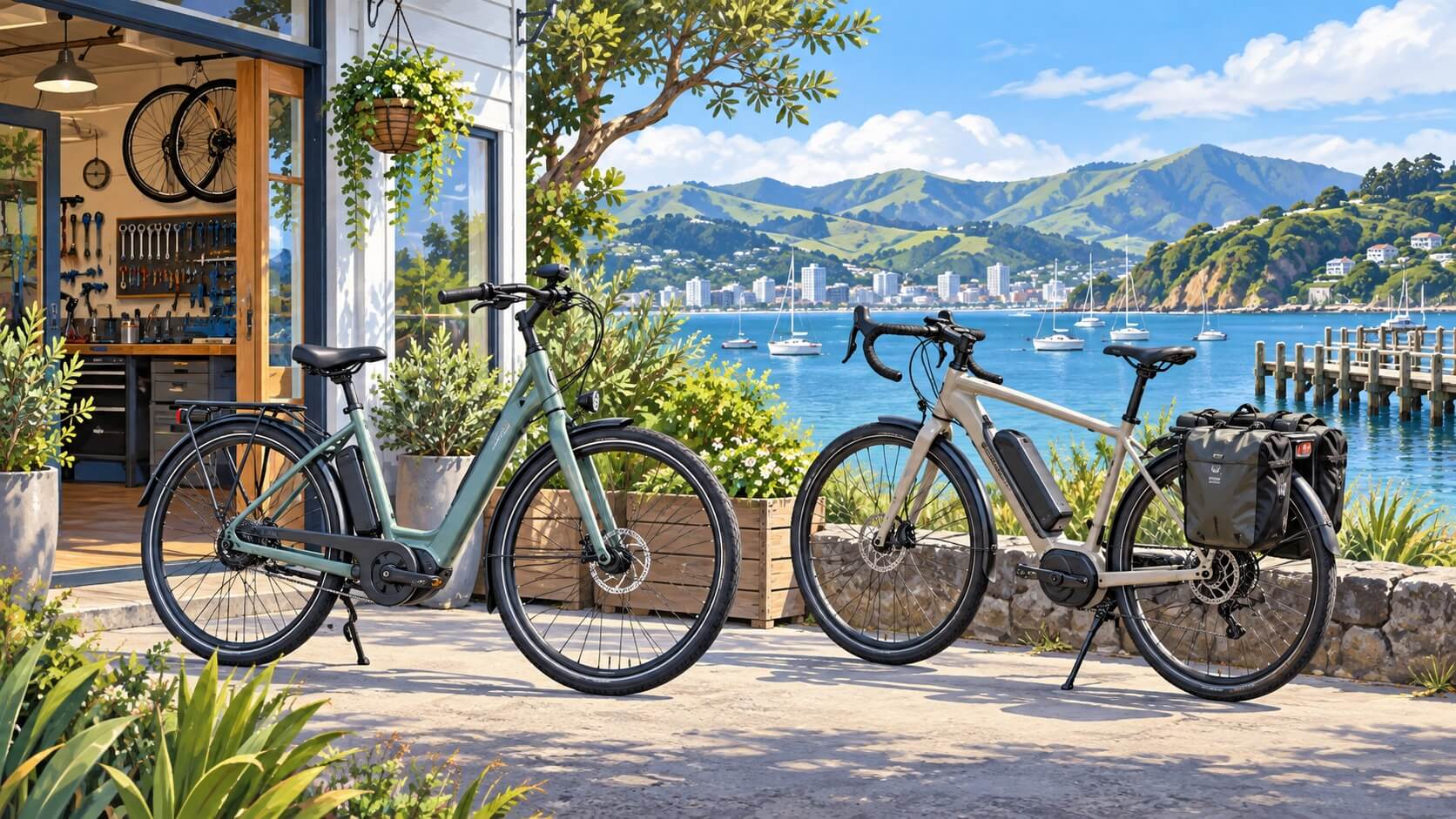
Compare the six brands and their NZ support routes
The order below groups buying choices rather than awarding quality scores. A local brand story, an official NZ sales channel and local manufacturing are separate claims. None of the sources used here establishes that all shortlisted bicycles are manufactured in New Zealand.
| Brand | Origin and NZ presence | Useful starting point | Support evidence to follow |
|---|---|---|---|
| Sinch | NZ-founded brand; its own NZ site sells the range | Jaunt low-step models for everyday and leisure use | Official customer service and Where To Buy pages; ask for a named nearby workshop |
| Wattwheels | NZ business with an official national stockist list | Oxford low-step commuter; separate cargo, folding and trail options | Stockists by region and a service enquiry route |
| Smartmotion | Its company history describes a New Zealand and China team; official dealer list includes NZ locations | Ecity, E20 and Xcity families, subject to the dealer’s current NZ specification | Brand-listed dealer, model-specific parts and warranty confirmation |
| Giant | Taiwan-origin brand with an official NZ catalogue and retail channel | Explore E+ trekking and everyday models | NZ store finder and retailer collection; verify that the chosen shop services the system |
| MeloYelo | NZ-owned brand, according to its official company account | Current model selected through a local demonstration | Named regional agents and a national support team; confirm the named repair contact and backup route if the agent is unavailable. |
| Trek | US-origin brand with an official NZ catalogue | Marlin+, Rail+ or Checkpoint+ for different riding tasks | Official NZ model catalogue and retailer enquiry route; trail and drop-bar gravel bikes are not substitutes for an equipped urban commuter. |
Origin sources: Sinch’s founders, Wattwheels’ company story, Smartmotion’s company history and Giant’s company background. A retailer outside a brand’s own list may still be legitimate, but its listing alone does not establish authorised-dealer status.
NZD prices: compare the model, battery and included equipment
These examples show how to compare a quote. They are not a survey of average prices or proof of better value. Check the selected size, model year and battery option before treating two prices as equivalent. Delivery, fitting and accessories can change the amount you pay.
| Official model page | Displayed price, NZD | Specific detail worth checking | Question for the seller |
|---|---|---|---|
| Wattwheels Oxford LS V3 | $3,999 | 500 Wh listed; 672 Wh upgrade listed at an extra $299 | Which frame/wheel version and battery does this quote include? |
| Sinch Jaunt EZ 2.5 Anthracite | $5,999.99, tax included on page | Removable Shimano 630 Wh battery; page lists 28.8 kg total bike weight | Can you demonstrate battery removal and confirm the weight of my chosen size? |
| Giant Explore E+ 3 45km/h, 2026 | $6,299 RRP | NZ-specific model designation, with retailer collection available | What is the exact NZ build and which shop handles diagnostics? |
| Giant Explore E+ 2 45km/h, 2026 | $7,399 RRP | A different build within the same model family | Which equipment changes justify the difference for my route? |
The Smartmotion international catalogue does not provide a verified NZD quote for this comparison. Request one from an officially listed NZ dealer. Do not convert an Australian price and assume it is the local delivered price.
Oxford versus Sinch: what the extra money changes
The current manufacturer lists give two differences beyond battery capacity. Oxford specifies an Ananda M81 mid-drive with an eight-speed Altus drivetrain and 11–32T cassette; Jaunt specifies Shimano EP600 with a nine-speed CUES drivetrain and 11–46T cassette. Cassette spans alone do not establish which bike climbs your hill better: wheel size, chainring, assistance and rider input also matter.
Sinch separates 25.1 kg bicycle weight from a 3.7 kg battery, totalling 28.8 kg. Removing its battery leaves 25.1 kg according to those published figures, before added equipment. That remains above a hypothetical carrier position rated at 25 kg, so battery removal alone would not make that example acceptable. Follow the maker’s removal procedure and the actual carrier instructions. Our car-transport guide explains per-bike and total rack limits.
Source basis: the linked Oxford LS V3 and Jaunt EZ 2.5 pages, reviewed 8 October 2026. These are specification comparisons and calculations, not Jimsen ride tests, legal approvals or predicted kilometres per charge.
What each shortlist entry helps you decide
Sinch: compare fit and lifting as carefully as battery size
The Jaunt EZ 2.5 combines a low-step frame with a removable battery. Those features address different needs: mounting the bike and charging away from it. Neither tells you whether you can lift it onto your car carrier. At the published 28.8 kg total weight, a buyer should check the carrier’s per-bike allowance and loading method before ordering. Verify the specific size and fitted accessories with the seller.
Sinch’s Where To Buy page provides the brand’s channel entry point. Ask who can diagnose the fitted Shimano system, and who supplies its replacement battery. The practical next step is a test ride followed by a written quote identifying the frame size and battery part number.
Wattwheels: local service visibility, with a load-limit check
Wattwheels publishes stockists by NZ region and a service support form. Its website states that it holds spare parts in New Zealand. Treat that as a supplier statement: obtain availability for the particular battery, display or other part you may need.
The Oxford page gives a useful constraint: a 120 kg total limit covering the bicycle, rider and cargo. Its listed 26–27 kg bike weight leaves about 93–94 kg for the rider and cargo by subtraction. This is a calculation from the stated model limits, not a test or a general Wattwheels rating. Count fitted accessories and confirm the final configuration. A low-step frame alone says nothing about permitted payload.
What an online Sinch purchase includes
Sinch’s customer-service guidance, checked on 29 September 2026, describes delivery of an online bike order to a selected authorised Experience Centre for assembly by a qualified mechanic and collection. It states that this bike-delivery route is to the centre, not the buyer’s home. Confirm the centre and handover appointment for your order rather than treating online purchase as home delivery.
For a buyer far from a centre, calculate the collection and possible repair journeys before comparing prices. Ask the centre to explain the included initial service check, subsequent service charges and warranty-claim route. A published handover process is not a guarantee of a particular appointment or parts availability.
Smartmotion: establish which regional version you are buying
The Smartmotion catalogue separates city, folding and trail families. That makes it a useful brand to investigate when storage or mixed recreational riding shapes the shortlist. However, an international model page can describe a different configuration from a local bike on the shop floor.
Ask the NZ dealer to identify the year, motor version and battery connector, then provide the matching manual. For an older or discounted bike, ask whether its battery and controller are still supplied. A low purchase price is less useful if the electrical replacement route is unclear. Our battery-health guide explains checks that do not require opening a pack.
Giant: use the NZ model page, not a global family headline
Giant’s NZ store finder and local collection information give a clear route to a retailer. That still leaves questions for the individual shop: will it diagnose the bike, who authorises warranty work, and which labour or transport charges might apply?
Explore E+ family pages cover multiple builds. The broad marketing description and an individual model’s component list can differ. Use the exact NZ model page and the seller’s itemised specification; do not transfer a battery, torque figure or belt-drive feature across the whole family. The 45km/h wording above is part of the source’s model name, not our recommendation to ride at that speed.
MeloYelo: compare the local-agent model with a conventional bike shop
MeloYelo adds an agent-based buying route to the NZ shortlist. Its official locator names regional contacts and says a national team backs the local agent. That can be useful if you want a guided demonstration near home, but establish what happens after the sale. Ask who performs routine mechanical work, who diagnoses electrical faults and where the bicycle goes if the original agent is unavailable. Confirm the current model and included equipment during the appointment. Compare this service journey with a conventional shop purchase rather than assuming a national contact list guarantees a workshop in every town.
Official source: MeloYelo local buying and support information (checked 29 September 2026).
Trek: add trail and gravel options without losing the route check
Trek’s NZ catalogue includes Marlin+ and Rail+ mountain-bike families and the Checkpoint+ electric gravel range. These expand the comparison when your goal is more than a low-step town bike. Decide first whether the actual trail or mixed-surface route calls for a hardtail, full suspension or drop bars, then check the manufacturer’s intended-use limits and the riding location’s rules. Ask the local retailer to identify the correct size and the support route for that drive system. Use the NZ specification and quote; overseas reviews are not evidence of the configuration supplied here.
Official source: Trek local buying and support information (checked 29 September 2026).
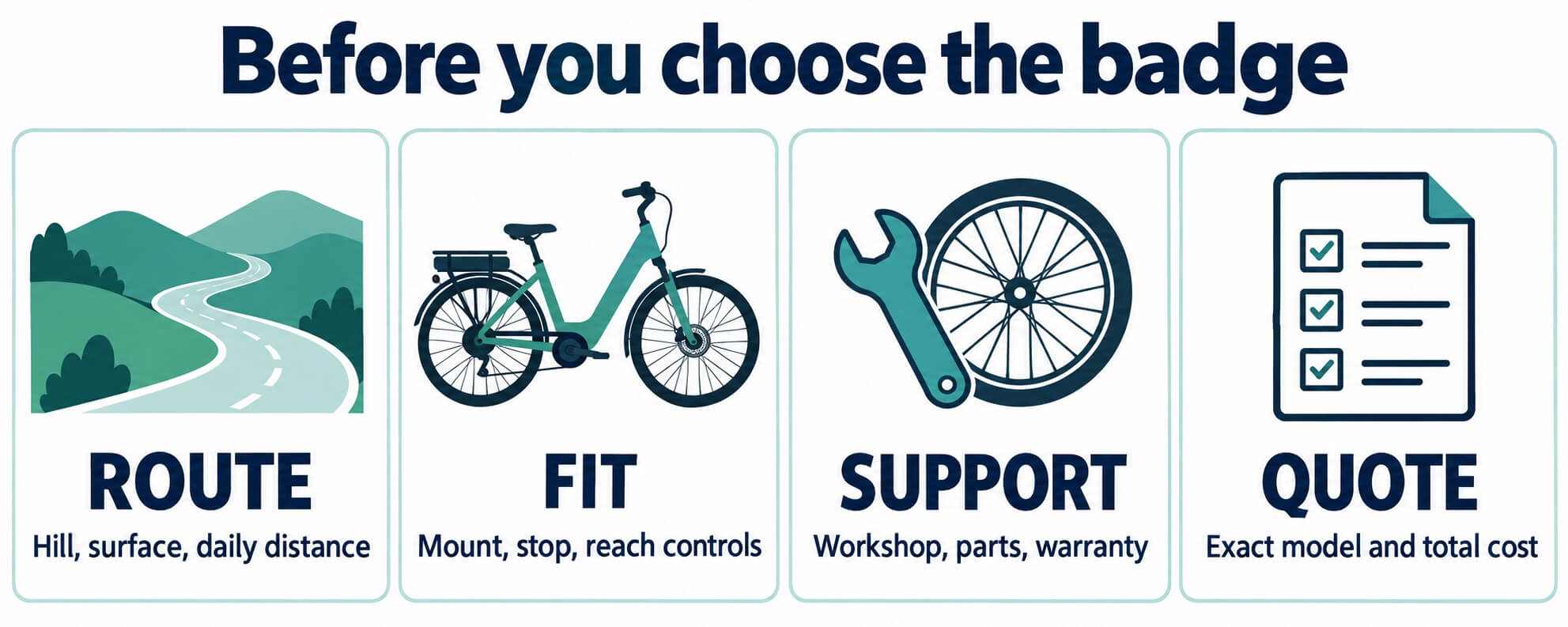
A city commute and a multi-day cycle trail place different demands on the same bicycle. Write down the daily distance, steepest hill and surfaces you plan to ride. Add the rider and luggage load, where you will charge, and any lifting needed at home. Give the same brief to each shop.
| Your use | What to demonstrate before buying | Evidence to take home |
|---|---|---|
| Stop-start commuting with a hill | Controlled starts, low-speed turns and an appropriate hill on the test route | Exact gearing and assist specification; a route-based range discussion with assumptions |
| Leisure rides and rail trails | Stable handling on a permitted representative surface; mounting with luggage fitted | Manufacturer’s intended-use category and the trail operator’s access rules |
| Motorhome or car-based trips | Lift or load the actual bike; check battery removal and carrier clearance | Bike weight and carrier per-position/total limits for the complete setup |
| Daily dependence with no spare transport | A conversation with the workshop that will perform electrical diagnosis | Repair booking route, compatible parts references and warranty responsibility |
For a Great Ride, use the official trail page rather than a brand’s maximum-range headline. The Remutaka Cycle Trail guidance, for example, warns about manoeuvring heavier e-bikes over rugged sections and lists no official e-bike charging points along the trail. That is a route-specific planning issue, not a reason to assume every NZ trail has the same facilities.
Ask the seller to explain the battery reserve for your distance and load, and arrange a charging or exit plan for longer rides. After purchase, use a manual-led maintenance schedule rather than waiting for a fault before the first inspection.
Check NZ classification separately from a sales claim
NZTA’s low-powered vehicle guidance describes a power-assisted cycle as having an auxiliary electric motor with maximum power no greater than 300 W and being designed primarily for propulsion by the rider’s muscular effort. It says cycle rules apply to that category. The same page discusses other vehicle categories separately; do not borrow the e-scooter section’s conditions and apply them to an e-bike.
A retail listing, speed headline or wattage sticker by itself does not settle every classification question. Ask for documentation for the exact unmodified NZ configuration. If its status is unclear, confirm it with NZTA before road use. This guide does not certify any shortlisted model’s legal status.
Trail access needs another check. Read the New Zealand Cycle Trails e-bike policy and the intended trail’s current conditions. A bike suitable for one commute is not automatically suitable or permitted on every recreational track.
Make the service promise specific
Before paying, ask the seller to complete these points in writing:
- Name the business that handles the initial fault report and the workshop that performs diagnosis.
- Identify the battery, charger and display by part number, including any model-year restrictions.
- Explain how replacement parts are ordered, whether the quoted part is in local stock, and what happens if it is discontinued.
- Separate the frame warranty from electrical components, normal wear and any labour or freight terms.
- State what a first service includes and whether it is included in the purchase price.
Under applicable NZ consumer law, a written warranty is not the only protection. Consumer Protection’s CGA guidance explains that businesses cannot restrict their obligations to store or manufacturer warranty terms. The remedy depends on the circumstances; this guide does not promise a refund for every fault. Keep the receipt and the agreed use/specification, and raise a problem with the retailer promptly.
Questions buyers ask
Which e-bike brand is best in New Zealand?
For a budget-led low-step commute, start with Oxford if you meet its combined load limit. Compare Sinch for its Shimano system and collection/assembly route; compare Giant or Trek for a specific trekking, trail or gravel model. Use Smartmotion or MeloYelo when their local version and buying route meet your needs. These are task-based shortlists, not comparative reliability results.
Does a New Zealand brand mean the bike is made in New Zealand?
No. Brand ownership, design, assembly and component manufacturing can occur in different countries. Ask for model-specific manufacturing information if origin matters to your purchase. A website-development credit saying “built in New Zealand” is not evidence about where the bicycle was built.
How much should I budget?
The verified examples above span NZ$3,999 to NZ$7,399, but they are a small selection, not the market’s minimum or maximum. Compare complete quotes including the right size, battery and necessary accessories. Keep a separate allowance for security and routine servicing based on local quotes.
Should I choose the biggest battery?
Choose enough capacity for the intended ride with reserve, then consider weight, removal and replacement availability. Do not treat battery Wh as a promised distance. Hills, load, assistance and weather change consumption, and a heavier bicycle can be harder to load or manoeuvre.
Can a general bicycle shop repair any e-bike?
Ask before buying. A shop may handle tyres and brakes but not have access to the electrical diagnostics or proprietary replacement parts for your model. Get acceptance from the workshop, rather than assuming that any nearby bicycle shop will take the job.
Your next step: request two comparable quotes
Send two local retailers the same route, rider/load, storage and budget brief. Ask for an exact model/year/size, the included equipment and a named service contact. Take the bike for a supervised test ride that reflects your daily use. Resolve any legal classification or intended-use uncertainty before paying.
For a dealer or importer building a product line, the decision is different: retail brand comparisons do not verify a manufacturing partner. Use our manufacturer procurement guide. For a Jimsen OEM/ODM enquiry, provide the target market, intended use, configuration and expected order scale, and request a feasibility response identifying the proposed specification, evidence needed and service-parts scope. This is not a claim that the shortlisted brands buy from Jimsen.
Brands and readers may submit factual corrections with an official source URL and the affected model/year. We update material facts when verified; inclusion is not a reliability test, endorsement or manufacturing-origin certificate.