
Buying a Used E-Bike: Battery, Ownership and Repair Checks
Before buying a used e-bike, verify who owns it, identify its battery and charger, check whether replacement parts and service are available, and inspect the bicycle before a test ride. A display showing 100% charge is not proof of battery health. Treat missing evidence as an unresolved purchase risk, not as something a short ride automatically clears. If ownership, battery safety or structural condition is doubtful, pause the purchase.
This guide is for a person buying a complete second-hand pedal bicycle. It is not a remote safety certificate, a battery-testing procedure or a guide to buying factory stock.
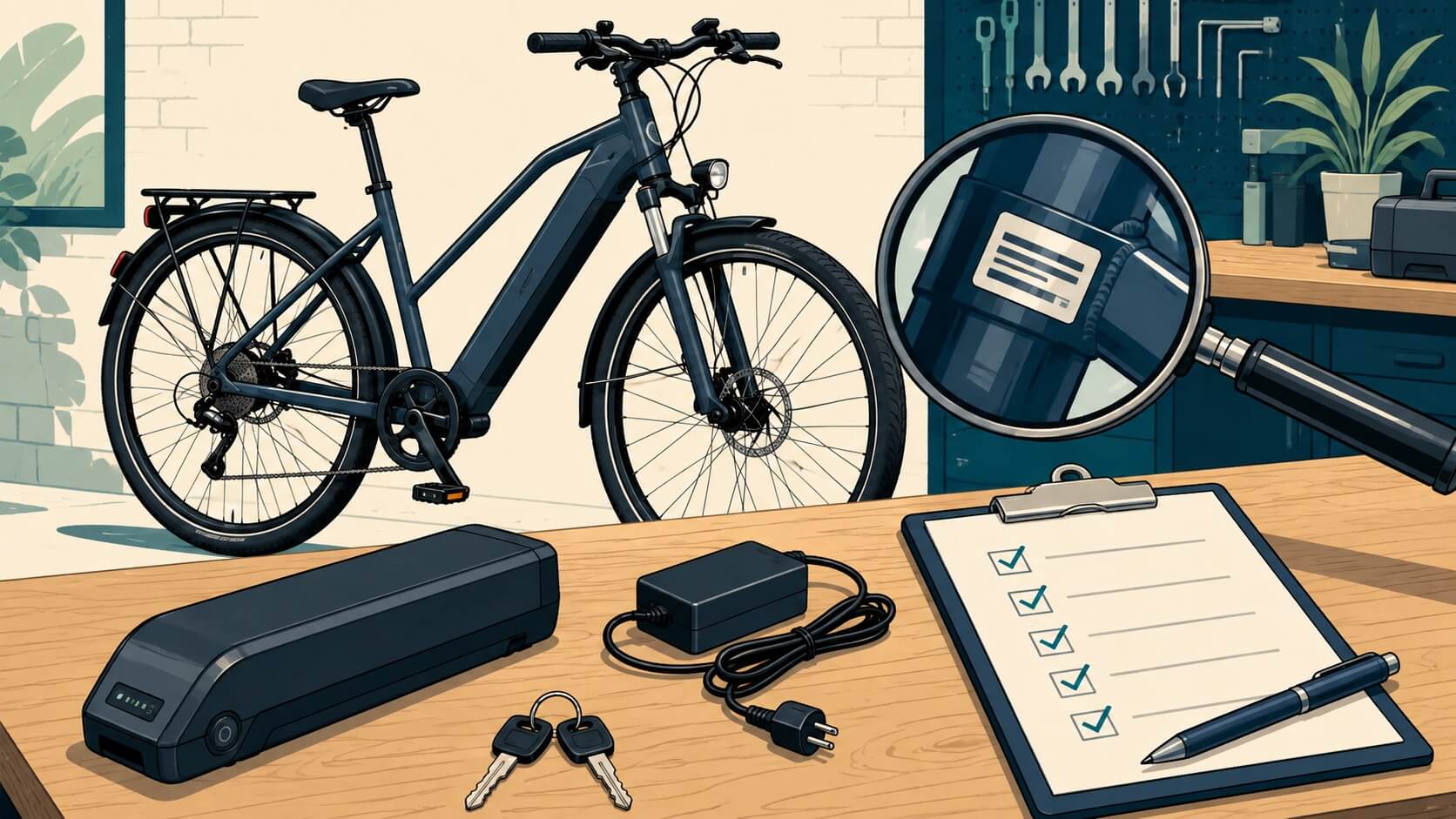
Send these questions before arranging a viewing
A recent Reddit used-e-bike discussion illustrates the buyer’s problem: the asking price is visible, but the battery history and repair path often are not. Community replies help identify questions; they do not verify the bike you are considering.
Could you send the exact model and year, current photos, frame number, battery and charger labels, proof of purchase, service records, and details of any crash, water damage, electrical modification or replaced component? Are both battery keys included? Can we arrange an inspection with a shop that supports this system?
Also ask why the owner is selling and which parts are included. Keep the conversation and listing together. A seller who cannot answer a technical question is not automatically dishonest, but an unanswered question should remain on your checklist.
A used e-bike checklist that separates evidence from assumptions
| Check | Useful evidence | What it does not establish |
|---|---|---|
| Ownership | Matching frame number, purchase history and sale receipt | A key alone does not prove ownership |
| Battery | Exact identity, history and an applicable current diagnostic report | Charge bars do not measure remaining capacity |
| Charger | Manufacturer-confirmed match to that battery/system | A plug fitting does not prove compatibility |
| Mechanical condition | Inspection plus a controlled ride after safety checks | A quiet short ride does not rule out hidden damage |
| Serviceability | A named repairer and confirmed replacement-part route | A similar-looking online part is not a confirmed replacement |
1. Verify the bike’s identity and ownership
Compare the frame number on the bicycle with the paperwork. Check an appropriate stolen-bike register in your country; in the UK, BikeRegister recommends checking the frame number, asking for purchase and service records, and obtaining a receipt for the sale. A database returning no match is not conclusive proof that a bike has never been stolen.
Stop if the number appears deliberately removed, the documentation belongs to another bike, or the seller will not resolve a material inconsistency. Do not confront someone you suspect of theft; use local police reporting channels. Agree a safe viewing arrangement and do not let pressure to pay replace the checks.
2. Ask what the battery evidence actually measures
Separate state of charge—how full the pack is now—from remaining usable capacity. Age, mileage and seller recollection are clues, not a measured health percentage. For the distinction and safe external observations, see our e-bike battery health guide.
Where diagnostics are available, ask for the report date, the battery serial number, the measured or estimated result, and any limitations. Bosch’s Certified by Bosch programme is one example of system-specific evidence: its documentation describes battery and drive information and serial-number verification. Its theft-status check is limited to reports in the eBike Flow app, not a search of police databases. Do not assume every used Bosch bike, every retailer or another manufacturer’s system supplies this certificate.
Ask a supporting dealer what can be established for this exact bike. Do not open the pack, probe unfamiliar terminals or deliberately run it flat to judge its condition. A swollen, leaking, damaged or unusually hot pack needs professional safety advice, not a test ride.
3. Confirm the charger and the repair path
Record the battery and charger part numbers, not just nominal voltage. Our charger compatibility guide explains why voltage and connector appearance alone are insufficient. The US CPSC’s charging guidance calls for the supplied charger, approved replacement batteries and attended charging; it warns against packs rebuilt by unqualified people or made with repurposed cells.
Before paying, ask the manufacturer or a supporting shop:
- Can you service this exact motor and electrical-system generation?
- Can you supply the correct battery, display, charger and battery-lock parts?
- What is available now, and what requires a confirmed order?
- Can any existing account lock be transferred through the manufacturer’s process?
Write down who answered. An unavailable battery is not merely an extra expense: until a compatible replacement is confirmed, the bike may not meet your intended use at any price.
4. Inspect before riding, then test your actual use
Ask a qualified bicycle mechanic to assess suspected frame damage, braking faults or loose components before a ride. Use our maintenance inspection guide to organise the discussion; a viewing is not a substitute for workshop inspection.
If the bike is safe to ride, start in a controlled area with permission. Check fit, starting, stopping, steering and ordinary gear changes, then the assistance modes you expect to use. Note exactly when an error, cut-out or unusual noise occurs. Do not attempt a steep loaded climb merely to stress an unknown bike.
A brief ride can show that a function works during that ride. It cannot establish full-charge range, long-term reliability or battery capacity. If the seller advertises a particular commuting range, ask what route, load and assistance level support that statement.
5. Compare the all-in cost, not just the listing price
Use actual written quotes for your decision. The following is arithmetic only, not a market-price estimate or Jimsen case study:
Illustrative total: 800 purchase + 90 inspection + 160 confirmed repairs = 1,050 currency units.
If battery condition remains unresolved, do not enter zero for that risk. Obtain a compatible replacement quote and compare a second scenario including that cost. If no replacement is confirmed, mark it “availability unresolved” instead of inventing a number.
| Decision | When it fits |
|---|---|
| Proceed to a documented purchase | Identity, condition, support and total cost are sufficiently verified for your needs |
| Hold for inspection or information | A repair quote, battery evidence or transfer process is missing |
| Walk away | Ownership is suspect, a safety issue is unresolved, or essential parts cannot be confirmed |
Common questions
What mileage is too high for a used e-bike?
There is no reliable universal cutoff. Compare the recorded use with condition, service history and the manufacturer’s support for that system. Low mileage does not settle battery storage history or hidden damage.
Is buying without a charger or battery key a bargain?
Only consider it after ownership is verified and the correct replacements are confirmed. Do not buy a generic charger to make an unknown pack work.
Is a refurbished bike automatically a safer choice?
Ask what was inspected, by whom, which parts were replaced and what written terms apply. “Refurbished” is a description to investigate, not a uniform inspection standard.
Should I negotiate or pay for an inspection?
Get the important unknowns resolved first. A discount does not make a damaged battery safe or create unavailable spare parts. Ask the shop for an inspection scope and price before booking.
Your next step
Copy the seller questions, identify a shop that supports the model, and take the evidence table to the viewing. For buying new stock for a dealership rather than one used bicycle, use the separate distributor procurement guide.
Sources checked: September 2026. Jimsen manufactures electric two-wheelers; this guide does not certify a used bicycle or claim a commercial relationship with the organisations cited.