
Buying an E-Bike in Singapore? Compare PAB Models, Prices and Rules
In Singapore, compare the exact approved PAB before comparing brands. MOBOT S3 addresses folding storage; JI-MOVE MC-PRO 3.0 offers the larger documented battery in this two-model comparison, but its standard warranty excludes commercial use unless separately agreed. Rider eligibility is a separate gate: you must be at least 16 and pass the PAB theory test before riding on roads or cycling paths. A registered bicycle does not make its rider eligible or allow riding on footpaths. The following guide separates these gates from price and equipment.
Approval list, S3 selection and JIMOVE warranty rechecked: 29 September 2026. Other model-price observations: 21 September 2026. LTA rider and route rules reviewed 8 October 2026; the dated model-list observations below have not been relabelled as a new approval check. Prices are Singapore dollars (SGD). Jimsen manufactures electric two-wheelers; inclusion is based on publicly verifiable information and does not indicate a commercial relationship or endorsement. This guide does not establish that a Jimsen model is approved for Singapore.
S3 versus MC-PRO · Rider and route gates · Approved model evidence · Buying questions
Why an overseas “best e-bike” list is not enough
A bicycle available overseas may not be the locally approved configuration. Brand reputation cannot answer whether the exact model, battery and sale route meet Singapore requirements. The LTA PAB guidance requires type approval, sealing and registration with a number plate. Technical limits include 250 W maximum continuous rated power, a maximum weight of 20 kg and pedal assistance cutting out at 25 km/h. PABs are not permitted on footpaths. LTA requires riders to be at least 16 and to wear protective gear; check the permitted route and all current rider requirements before buying.
Registration is also a handover task. For a registered bicycle, confirm the seller’s transfer process and complete the required ownership steps. Do not confuse receiving an invoice with completing registration. Refer to LTA’s current guidance rather than a marketplace seller’s abbreviated explanation.
Choose for compact commuting, longer shifts or delivery work
Personal commuting with limited storage
Put MOBOT S3 first for a folding-storage comparison: its product page lists S$1,499, a seven-speed drivetrain and a 36 V 11.6 Ah selection. The fold and seatpost battery are concrete reasons to investigate it. Its page also states two to three weeks after inspection, so a ready-stock label should not be read as same-day handover. The actual fold and lifting task remain a showroom check.
You are comparing battery capacity and equipment
JI-MOVE MC-PRO 3.0 lists S$1,799, front suspension and hydraulic disc brakes. Using the documented nominal labels, 48 V × 19.2 Ah is 921.6 Wh; S3’s selected 36 V × 11.6 Ah is 417.6 Wh. The MC-PRO is S$300 more on the checked listings and has about 2.2 times the nominal energy. That is a configuration comparison, not a promise of twice the distance, a full delivery shift or interchangeable batteries. Compare it when its battery and equipment matter more than S3’s particular storage layout.
You plan to earn income from deliveries
Do not choose the MC-PRO on delivery marketing alone. JIMOVE’s published warranty excludes commercial use unless separately agreed. If that exclusion remains, treat repair exposure as a purchase cost rather than counting on standard warranty cover. S3’s commercial-use coverage has not been established here, so it is not a verified warranty-safe alternative. A written commercial-use agreement is a genuine remaining gate, not a generic request for more information.
Prices, S3 selection and JIMOVE policy were rechecked on 29 September 2026. Both choices still require the exact approved model, battery and handover described below. We have not measured ride comfort, failure rates or real-world range.
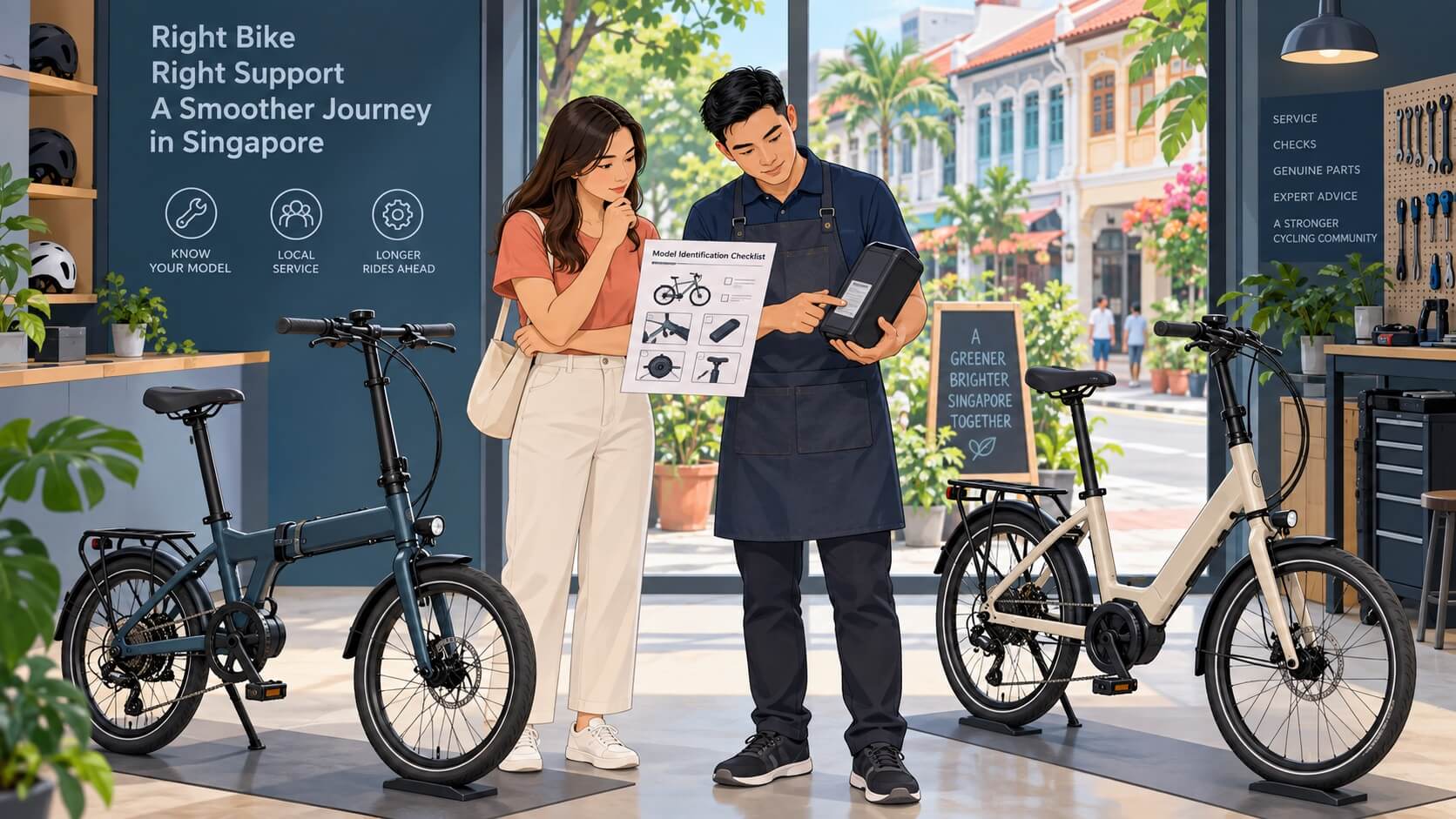
Two model examples, with evidence boundaries visible
We checked the LTA list headed List of Approved Power-Assisted Bicycle (PAB) Models, as at 01 July 2026, downloaded from the current official link. Search engines may show an older date for that same PDF address. Open the file and check its own heading.
| Model | Official model-list entry | Seller price observed | Resolve before ordering |
|---|---|---|---|
| MOBOT S3 | Page 10: battery NZ0131004, 36 V, 10.4 Ah / 11.6 Ah | S$1,499 on the product page | The current selector displays 11.6 Ah. Match the supplied battery label and written quote to the approved configuration. |
| JI-MOVE MC-PRO 3.0 | Page 5: battery SNHB1481920, 48 V, 19.2 Ah | S$1,799 on the product page | Confirm the exact 3.0 generation, battery identity, charger and after-sales terms. |
Source: LTA approved-model PDF. Its notes state that approval is retailer- and model-specific and is not an LTA endorsement. The entries are not permission to substitute a battery or import an apparently identical bicycle. Only the original approved battery specification and appropriate original charger should be used; the document also identifies the charger’s ESG SAFETY Mark requirement.
Prices are dated page observations, not reservations or delivery promises. Compare the final quoted package and tax treatment. A cheaper category-page banner may refer to a different promotion or configuration; ask the seller to resolve discrepancies before payment.
MOBOT S3: useful to examine when folding and storage matter
The MOBOT S3 product page describes a folding commuter with a seatpost-integrated battery. On 29 September 2026, its selector displayed 36 V 11.6 Ah. The LTA entry contains both approved capacity variants; that is not permission to substitute a pack or assume the order contains another capacity. Ask for the supplied battery’s label and the complete bicycle specification on your quote.
The practical question is whether the fold solves your storage problem. Ask for a demonstration, measure the space at home and assess the weight you would actually have to lift. Check transport-operator rules separately if you intend to take it on public transport. A folding description is not a universal boarding permission.
MOBOT has a Singapore-facing sales site and a service-and-repair route. That is evidence of a local contact point, not a measured repair turnaround or a guarantee that every replacement part is in stock. Ask which location accepts this model and what a diagnostic appointment involves.
JI-MOVE MC-PRO 3.0: confirm the generation before comparing features
JIMOVE’s MC-Pro 3.0 listing showed S$1,799 and describes front suspension and hydraulic disc brakes. Those are seller specifications, not our assessment of braking distance, comfort or durability. The older MC, MC-Pro and MC-Pro 2.0 names should not be treated as interchangeable with the 3.0.
For a rider spending long periods on the bicycle, a supervised fit and handling demonstration is more useful than a list of adjectives. Check control reach, mounting, low-speed manoeuvring and where your normal luggage would go. Have the seller explain the maintenance requirements of the actual fork and brakes. Do not infer that extra components always reduce ownership work.
The brand’s Singapore site provides a showroom/contact route and warranty information. Read the applicable conditions before purchase and ask who pays for diagnosis, labour and transport. A local website or a long advertised range does not establish the quality or speed of a future repair.
Local brand presence is not the same as local manufacture
MOBOT and JIMOVE operate Singapore-facing brand and sales channels; that is the local-market evidence used here. We have not established a manufacturing-country claim for every bicycle they sell. The approval document identifies Dongguan Lehe Intelligent Technology for S3 and Snapcycle Pte. Ltd for MC-PRO 3.0 as the respective PAB manufacturers. A company name in a record is not proof of where every manufacturing operation occurred.
If country of manufacture matters to you, ask for documentation for the exact unit. Do not convert a Singapore showroom address into a “made in Singapore” claim, or assume the battery manufacturer and the bicycle brand are the same organisation.
Can you use a PAB for your actual journey?
LTA’s rider and route rules separate the person, bicycle and path:
| Gate | Decision before buying |
|---|---|
| Rider | At least 16; pass the mandatory PAB theory test before road or cycling-path use. |
| Route | No riding on footpaths or pedestrian-only paths. Check signs along the whole route, not only its map distance. |
| Road segment | Wear a helmet. Expressways, road tunnels and selected viaducts are excluded. |
| Bicycle | Match approval, seal, registration and battery evidence to the supplied unit. |
Example: an approved PAB and a passed test still do not permit riding along a footpath shortcut. Plan a permitted alternative before paying. An inspection booking, purchase receipt or seller demonstration does not replace the rider’s theory test. Rules reviewed 8 October 2026.
For parking at either end, use our frame, wheel and battery locking guide; local parking rules remain separate.
Use five checks at the showroom
- Identify: photograph or record the precise model generation, bicycle identifiers and supplied battery label with the seller’s assistance.
- Verify: have the seller demonstrate how the unit and sale route correspond to current official requirements. Resolve any mismatch before paying.
- Fit: test the mounting and handling tasks under the seller’s supervision. Check storage access and the load you actually intend to carry.
- Support: name the workshop, ask about electrical diagnostics and request the ordering process for the correct charger, battery and display.
- Handover: obtain manuals, charger identification, invoice, written warranty terms and completed registration or transfer instructions.
For delivery work, add a downtime question: “If this exact model cannot be used tomorrow, where does it go and what happens next?” Ask about appointments, assessment charges and parts availability. JIMOVE’s published warranty excludes commercial use unless agreed otherwise, despite its product marketing mentioning delivery riders. Obtain written confirmation for your intended use rather than assuming that marketing language establishes coverage. There is no basis here for promising a particular number of daily deliveries or kilometres between charges.
Plan the route before choosing the bicycle. A short map distance can be misleading if the convenient shortcut is not a permitted PAB route. Inspect the parking and storage arrangements at both ends and determine where approved charging can take place.
Battery figures help identify a configuration, not predict your shift
Voltage and amp-hours alone cannot establish real-world range. Load, assistance, route and conditions affect consumption. The table’s numbers identify documented configurations; they are not an invitation to fit a larger pack. For everyday ownership, follow a model-led maintenance schedule and use the correct charger compatibility checks. General technical explanations do not override local approval conditions.
Common questions
Does buying a registered PAB mean I can ride it immediately?
You still need to meet rider requirements, including the PAB theory test, and complete the required ownership handover. Registration and rider eligibility are separate.
Is every e-bike sold by an approved brand allowed?
No. A brand name is not a unit-level compliance check. Verify the precise model, configuration and seller route, and complete the required handover checks.
Is a bigger battery the better purchase?
Not automatically. It may not be an approved alternative for the bicycle, and capacity does not resolve fit, support or route suitability. Compare only the correct configurations and your actual needs.
Does a water-resistance claim mean I can ignore the manual?
No. Ask for model-specific wet-use, cleaning and inspection instructions. Marketing wording is not evidence that immersion, pressure washing or every wet condition is acceptable.
Which of these two models is best?
Start with S3 if the folding layout solves your storage problem. Compare MC-PRO 3.0 for its larger documented energy capacity and listed suspension/brakes. Delivery buyers must resolve its commercial-use warranty exclusion first. These are specification-led choices; we have not measured range, comfort or reliability.
What changes if I am sourcing a product line?
A retailer’s consumer offer does not qualify a manufacturing project. Start with our procurement guide and separately establish the intended market’s approval, configuration and after-sales responsibilities. Do not assume an existing approval transfers to a new importer or configuration.
Next step: ask the seller for one written package containing the exact model, battery, ready-to-ride total and service arrangements. Brands or retailers may submit factual corrections with current evidence. Recheck official requirements and prices when purchasing.