
Class 1 vs Class 2 vs Class 3 E-Bikes: Which Should You Choose?
In the common US three-class system, Class 1 means pedal assistance up to 20 mph, Class 2 allows throttle-powered riding up to 20 mph, and Class 3 means pedal assistance up to 28 mph. These are motor-assistance limits, not an absolute limit on how fast the bicycle can roll. A class also does not tell you its range, hill-climbing ability or build quality. State definitions and route rules can differ: New York, for example, uses a different Class 3 definition. Start with the comparison below, then read the state exceptions before choosing a bike.
US buying guide · Legal sources checked October 10, 2026. Illustrations explain configurations; they are not Jimsen road-test results.
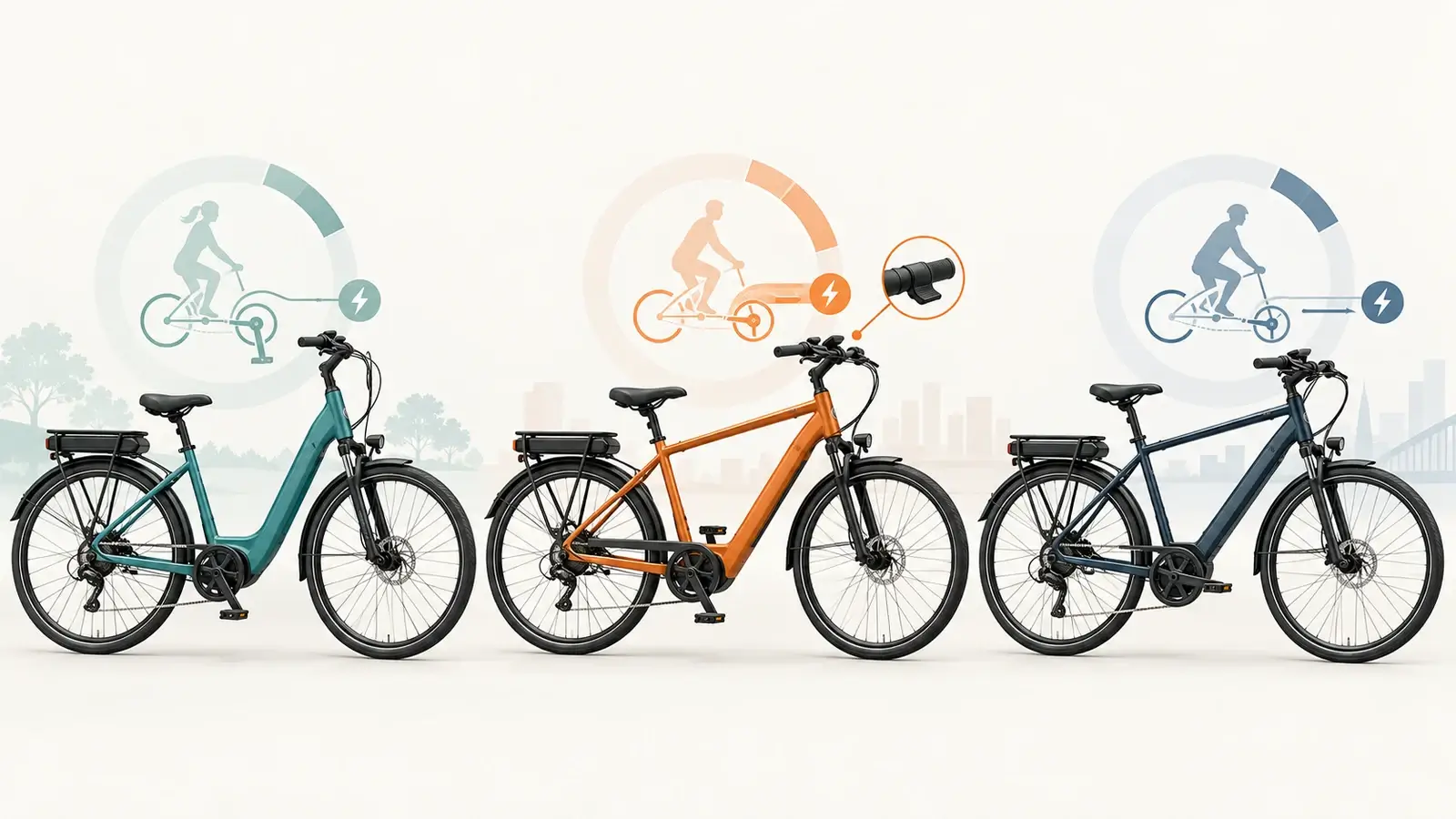
Class 1 vs Class 2 vs Class 3: the differences that matter
This table describes the familiar three-class model, not every state’s current law. California’s 2026 guidance follows this basic pattern, with additional conditions explained below.
| Feature | Class 1 | Class 2 | Class 3 |
|---|---|---|---|
| Pedaling for normal assistance | Required | Not required when using the throttle | Required |
| Assistance ceiling | 20 mph / about 32 km/h | 20 mph / about 32 km/h | 28 mph / about 45 km/h |
| Throttle riding without pedaling | No, in this model | Yes, up to the class limit | No, in this model; state exceptions matter |
| What the class describes | Pedal-dependent motor operation | Motor-only operation is possible | Higher-speed pedal assistance |
| What it does not establish | Range, torque, battery quality, certification, trail permission or whether a particular model complies with local law | ||
Source: California Highway Patrol, May 2026 e-bike guidance. Do not use the class label alone as permission to ride on a particular road or trail.
Class 1: assistance follows your pedaling
A Class 1 bike adds motor assistance while you pedal, up to its assistance ceiling. It can suit someone who wants cycling to remain the main activity while getting help with starts, headwinds and climbs. A cadence-based system and a torque-based system can both be Class 1, but they can respond differently to your pedaling.
“Pedal assist” does not mean the motor provides no help at low speed. It means normal riding assistance depends on pedaling. A permitted low-speed walk or start function is a separate issue, not unrestricted throttle riding.
Class 2: throttle control is the key difference
Class 2 can power the bike without continuous pedaling. Many models also offer pedal assistance, so the rider can choose between the two controls. A throttle may be useful when setting off repeatedly or when a rider needs a break from pedaling. It does not guarantee an easy start on every hill: available torque, load, gearing and the controller still matter.
A throttle is a control, not a promise of motorcycle-like performance. Ask whether it operates from a standstill, requires an initial pedal movement or has another manufacturer-defined activation condition.
Class 3: faster assistance, not automatically a better bicycle
In the common model, Class 3 extends pedal assistance to 28 mph. That may be valuable on a lawful road commute where the rider can actually sustain that pace. It can be less useful on a congested route with frequent stops or a shared path with a lower riding speed limit.
Neither “Class 3” nor “28 mph” proves that a bicycle climbs better, carries more cargo or has stronger brakes than a Class 1 model. Those are separate specifications. Class 3 also brings different age, helmet and access requirements in some jurisdictions.
How do I tell what class my e-bike is?
Match the bike’s class label to the manual for its exact model and market, then check that the fitted controls and documented operating modes agree. A motor wattage sticker, frame style or current display setting cannot establish the class by itself.
- Photograph the class label and model or serial-number label. Note the stated assistance limit and power figure where provided.
- Find the manual for that model, year and destination market. Read its pedal-assist, throttle, start/walk-assist and speed-limit instructions. A different regional version of the same model may have different controls.
- Check whether the bike still has its original controller, throttle and software settings. Record a firmware version if the ordinary display menu or manufacturer documentation provides it; otherwise record “not provided.” Do not open electrical components or use an unlock tool to identify the bike.
- Compare the documented behavior with the class definition in your state. The scenario table below helps distinguish normal throttle riding from start/walk assistance. Do not conduct a high-speed cut-off test on a public road to settle the question.
What if the label, manual and actual configuration disagree?
Treat the classification as unconfirmed. For example, a Class 1 label combined with unrestricted throttle riding needs investigation; selecting a slower mode does not resolve the mismatch. Send the manufacturer or authorized service provider the model/serial number, label photos, manual revision and any known modifications. Request written confirmation of the approved configuration and the matching label/manual, or a documented repair to restore it.
Until the mismatch is resolved, do not assume permission to use a class-restricted route or rely on the disputed function. Stop assisted riding if the motor behaves unexpectedly or fails to stop as the manual describes. A replacement sticker alone cannot make a non-qualifying vehicle a legal e-bike; California’s current guidance, for example, requires modified bikes to remain within its e-bike definition.
How PAS, throttle, torque sensors and controllers work together
PAS means pedal-assist system. A torque sensor is one way that system detects rider input; it is not a fourth riding mode or a separate e-bike class. A cadence sensor detects pedal rotation. A torque sensor measures pedaling force. Some systems combine both, along with wheel-speed information.
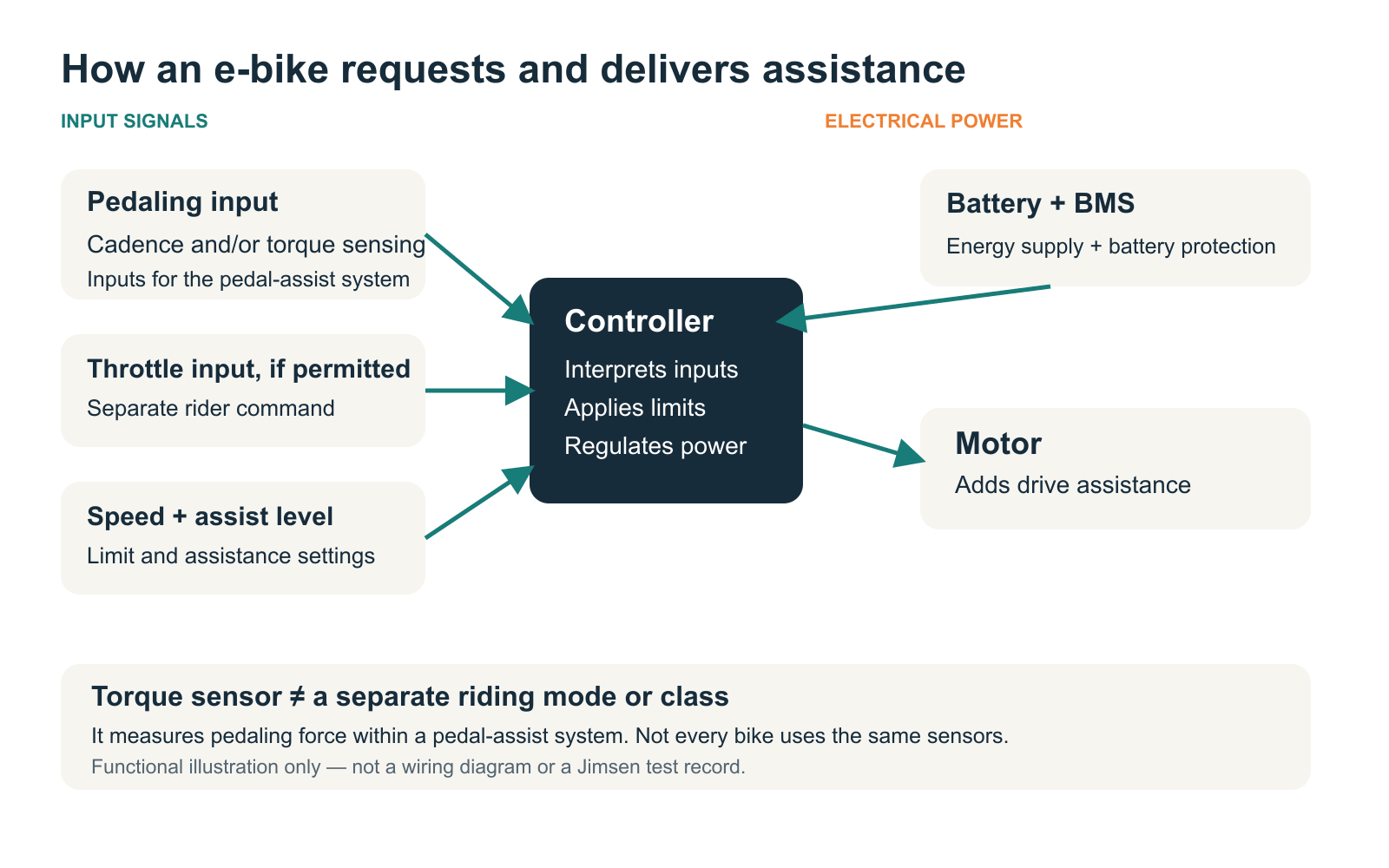
The controller interprets the permitted inputs, the selected assistance level and the speed limit, then regulates electrical power to the motor. The battery management system protects the battery within its designed limits; it is not a substitute for correct vehicle configuration.
For a concrete manufacturer example, Tern explains its Bosch assistance using torque, cadence and speed measurements. That explanation applies to the described Bosch-equipped bikes, not every throttle or controller on the market.
Two bikes with the same class can feel different because of sensor behavior, firmware tuning, motor placement and drivetrain gearing. On a test ride, compare a gentle pedal start, a harder pedal input and a restart on the kind of hill you expect to use. The class number will not answer those questions. Motor power is another separate comparison; see our e-bike motor wattage guide.
What happens when you pedal, use the throttle or stop?
The following scenarios describe three conceptual configurations matching the common class model. They are not observations from one switchable Jimsen test bike.
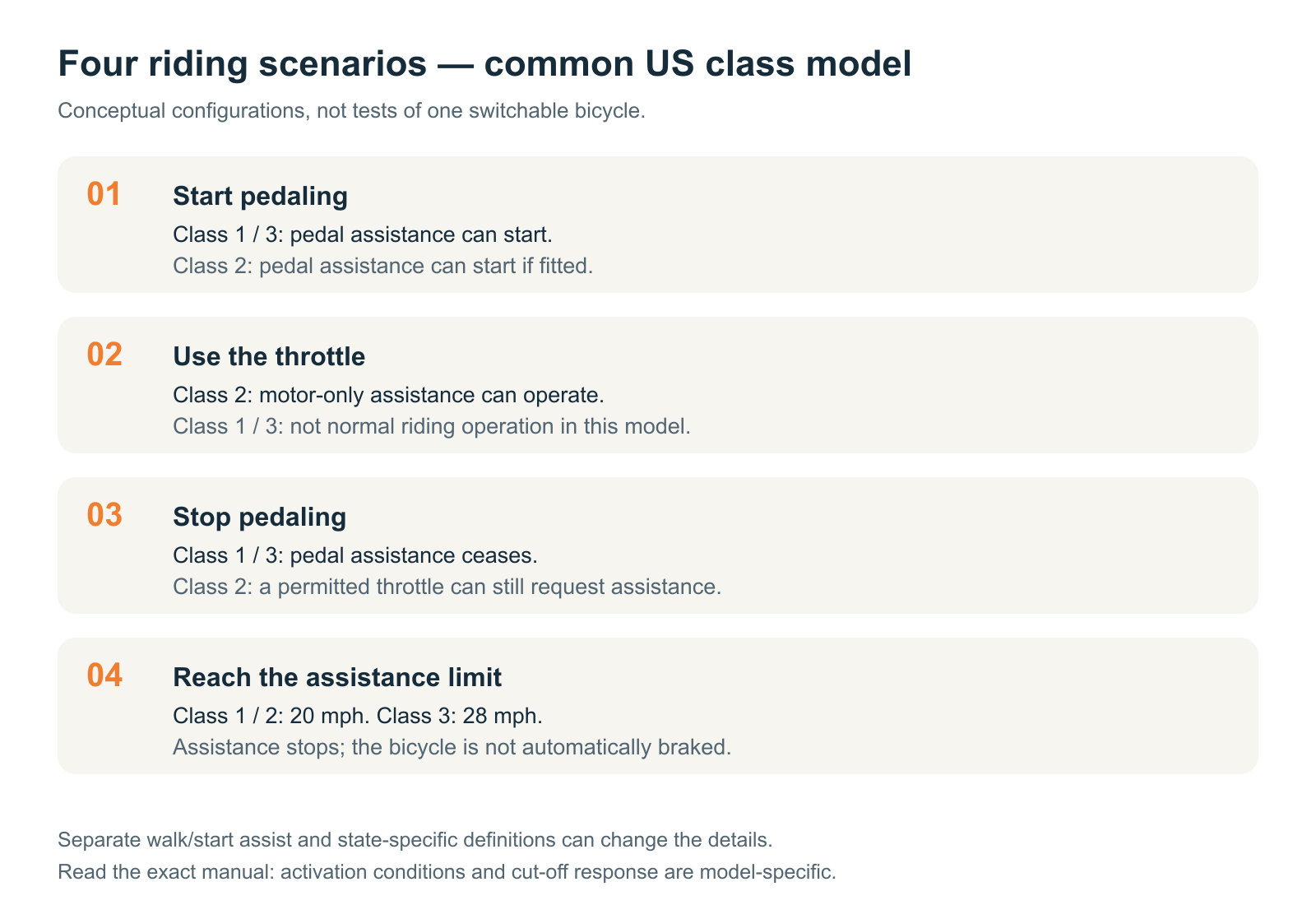
| Rider action | Class 1 | Class 2 | Class 3 in the common model |
|---|---|---|---|
| Begin pedaling below the assistance limit | Pedal assistance can start | Pedal assistance can start if fitted | Pedal assistance can start |
| Use a throttle without pedaling | Not normal riding operation | Motor-only riding can operate | Not normal riding operation |
| Stop pedaling below the limit | Pedal assistance ceases | PAS ceases; a permitted throttle can still request assistance | Pedal assistance ceases |
| Reach the assistance ceiling | Motor assistance stops at 20 mph | Motor assistance stops at 20 mph | Motor assistance stops at 28 mph |
Motor cut-off is not automatic braking. The bicycle can keep moving through momentum, downhill gravity or your own pedaling. If a bike stops assisting around its configured limit, that is different from an intermittent fault. Unexpected loss of assistance below the limit belongs in a separate diagnosis: why an e-bike motor cuts out.
Do not assume every bike has a brake-lever electrical sensor or identical cut-off timing. Read the controls section of the exact manual. A rider should still release the throttle and brake normally; a motor-disengagement feature does not replace brake maintenance.
US e-bike laws: why the three numbers are not the whole answer
Federal product definition and state riding rules are different
15 USC §2085 defines a low-speed electric bicycle for federal consumer-product purposes using operable pedals, a motor below 750 watts and a motor-only speed below 20 mph under its specified level-surface test with a 170-pound rider. It does not create a nationwide permission to ride every advertised “Class 3” bike anywhere bicycles are allowed.
State vehicle definitions, local access restrictions and the land manager’s rules answer different questions. “Below 750W” in the federal definition and “not exceeding 750W” in some state definitions are also not identical wording. Avoid treating a retailer’s 750W badge as a complete compliance check.
Three current examples that change a buying decision
- California: CHP’s 2026 guidance allows a separate start/walk-assist function up to 3.7 mph on Class 1 and Class 3 bikes. Class 3 requires a speedometer; operators must be at least 16, and operators and passengers must wear helmets. Local restrictions can still apply. A product intended to be modified for motor-only speeds above 20 mph may fall outside the state’s electric-bicycle definition. Read the current CHP guidance.
- New York: its statutory Class 3 allows motor-only operation up to 25 mph and is limited to a city with a population of at least one million. That is not the usual pedal-only, 28 mph definition. Read New York VAT §102-C.
- New Jersey: 2026 MVC guidance distinguishes low-speed pedal-assisted bicycles from motorized bicycles and introduces licensing and registration requirements. Insurance is required for motorized bicycles, not low-speed electric bicycles. Do not rely on an older “no license needed” summary. Read current New Jersey MVC requirements.
These examples are not a 50-state legal survey. They show why an article, retailer or controller menu cannot settle legality on its own. For a purchase, record the state, city and actual route, then compare the official definition with the exact model’s throttle operation and speed settings. For parks and trails, obtain the managing authority’s route rule rather than inferring access from the class label.
Does selecting “Class 1 mode” make a switchable bike Class 1?
Not necessarily. A lower setting may change riding behavior without changing the product’s legal classification. Relevant law can consider the bicycle’s capabilities and intended modification, not just today’s selected mode. A removable throttle, hidden unlock menu or software speed setting is therefore not proof that the model qualifies for a restricted route.
For a switchable model, the useful documents are the exact manual, class label, factory configuration and official rule for the intended jurisdiction. A screenshot showing “20 mph mode” is not enough.
20 mph vs 28 mph: the safety difference is larger than eight miles per hour
At 28 mph, a bike travels 40% farther during the same reaction time than at 20 mph. Under equal constant deceleration, braking distance is about 96% greater. The second result follows from speed squared, not from a road test. Total stopping distance combines reaction distance and braking distance, so its percentage increase is different.
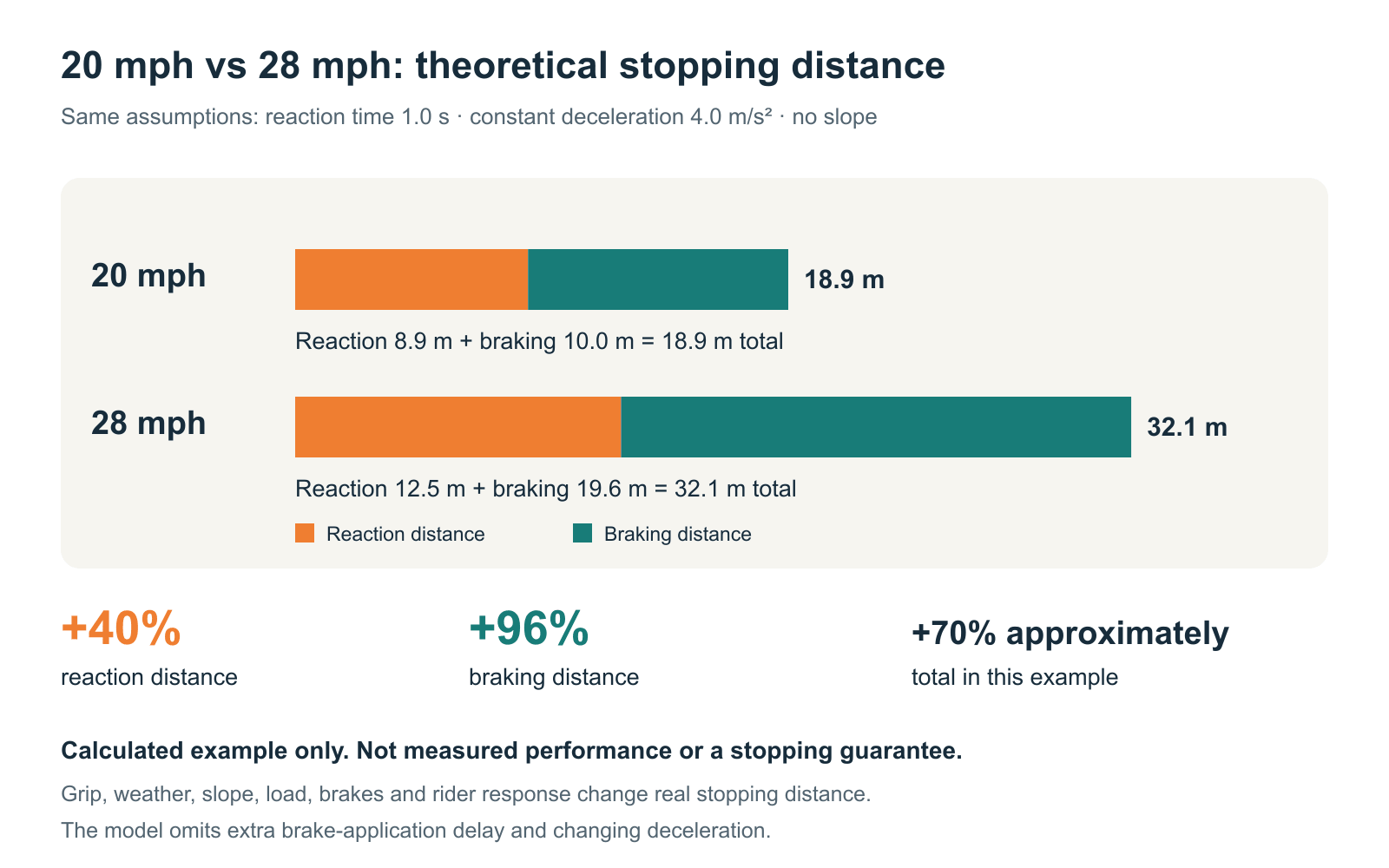
Reaction distance = speed × reaction time
Braking distance = speed² ÷ (2 × deceleration)
| Speed | Reaction distance | Braking distance | Total |
|---|---|---|---|
| 20 mph / 8.94 m/s | 8.9 m / 29.3 ft | 10.0 m / 32.8 ft | 18.9 m / 62.1 ft |
| 28 mph / 12.52 m/s | 12.5 m / 41.1 ft | 19.6 m / 64.3 ft | 32.1 m / 105.3 ft |
The assumed 4.0 m/s² deceleration is chosen for explanation; it is not a specification for Jimsen bikes or a universal value. Real stopping distance changes with grip, water, slope, load, tire condition, brake condition, reaction time and how the rider applies the brakes. This simple model also omits additional brake-application delay and changing deceleration.
At the same combined rider-and-bike mass, kinetic energy also rises with speed squared: 28 mph carries about 1.96 times the energy of 20 mph. That helps explain why a higher assistance ceiling should prompt closer attention to braking and available sight distance, not just commute time. See our brake-pad inspection and replacement guide for inspection-based maintenance.
Which e-bike class should you choose?
Choose the route first, then the control you need, then the bicycle’s fit and specifications. Buying the fastest class first and discovering that the intended route excludes it is a costly way to decide.
| Your main need | Start by comparing | The decision that matters |
|---|---|---|
| Pedaling remains the main activity | Class 1 | Assistance feel, fit and the rules on your actual route |
| Motor help without continuous pedaling | Class 2 where permitted | Throttle activation, loaded starts and local classification |
| Faster pedal-assisted road commuting | Class 3 where permitted | Whether the route supports that pace; braking, helmets and rider eligibility |
| Steep hills or cargo | Any permitted class | Motor torque, gearing, load rating, loaded brake performance and fit |
| Shared paths or natural trails | The classes explicitly allowed there | The land manager’s rule and riding speed limit, not a general class recommendation |
Will Class 3 shorten a commute?
It can, if higher assisted speed is useful and lawful along that route. For a purely mathematical 10-mile ride with no stops, 20 mph takes 30 minutes and 28 mph takes about 21.4 minutes. Those are constant-speed calculations, not a commuting forecast. Junctions, traffic, route restrictions, climbs and parking may absorb much of that difference.
Which class has the longest range?
The class alone cannot tell you. Battery energy, assistance level, route, load and speed all affect consumption. A higher speed setting does not create more battery energy. Compare range claims only when test conditions and the exact configuration are stated; a Class 1 and Class 3 advertised range may have been measured on completely different assumptions.
Which is better for hills or heavier riders?
There is no class winner. Compare the complete bicycle’s rated load, drivetrain, torque delivery, gearing and brakes. A low-speed climb can demand considerable torque even though the bike is nowhere near 20 or 28 mph. That is why assistance ceiling and climbing performance need separate answers.
Before buying: seven checks beyond the class number
- Match the exact bike to the rule. Check the model and configuration, not a general brand claim. Compare its operating modes with the official state definition.
- Identify what the throttle actually does. Distinguish normal riding, start assistance and walk assistance. Read the activation conditions and speed limit for each.
- Read power terminology carefully. Rated power, peak power and controller current are different figures. An unexplained peak number does not establish compliance or climbing ability.
- Check load, fit and brakes separately. Include rider, bike accessories and cargo in the manufacturer’s applicable limits. A class designation is not a payload rating.
- Check the electrical system, not just the speed. Match the battery and approved charger. Where certification is claimed, verify the exact model and the scope of the record.
- Check service and replacement parts. Know who services the motor and controller and whether a compatible replacement battery is available. This is independent of Class 1, 2 or 3.
- Check access before paying. Include the road, shared path and trail sections of the intended route, along with applicable rider-age and helmet rules.
UL distinguishes UL 2849 for e-bike electrical systems from UL 2271 for light-electric-vehicle batteries. Neither is a class designation. A certified component also does not automatically establish that the whole bicycle’s electrical system is certified. This guide makes no certification claim for a Jimsen model.
For dealers and importers: specify the class as a configuration requirement
A purchase specification should name the destination jurisdiction and intended vehicle category, then define pedal-dependent assistance, throttle behavior, assistance ceiling, power-rating basis and labeling. “US compliant” without those details is too broad to compare quotations.
The sample review should demonstrate the agreed operating modes, including normal pedal assistance, throttle behavior if applicable and assistance cut-off. Inspection records should identify the tested configuration; changing controller software, throttle hardware or another relevant component needs review rather than an assumption that the earlier result still applies. This is a proposed review checklist, not a claim that Jimsen has performed these tests on a particular model.
Sample configuration and class confirmation record
Use one record for each sample configuration. Fill in the agreed requirement before evaluation, then attach the actual observations and evidence. The table below is a blank record template, not a completed test report or a certificate of legal compliance.
| Item | Agreed requirement | Record and evidence to attach |
|---|---|---|
| Sample identity | Model, serial/sample ID, destination state, intended class and review date | Configuration sheet, unit-label photos and evaluator’s name |
| Hardware and firmware | Controller/display part numbers, motor and battery configuration, approved software versions and settings | Part-label photos and available version/settings screenshots; identify any version not provided |
| Pedal assistance | Permitted activation conditions and behavior when pedaling stops | Observed behavior, selected mode, test conditions and dated video/report reference |
| Throttle and start/walk assistance | Whether each function is fitted, when it activates and its specified limit | Separate observations for normal throttle riding and start/walk assistance; mark absent functions not applicable |
| Assistance cut-off | Limit for each permitted mode and agreed verification method | Measured assistance behavior, speed-measurement method, conditions and uncertainty; use a suitable controlled test facility |
| Class label | Class, power and assistance-limit information required for that jurisdiction | Legible photo matched to this sample and configuration |
| Manual | Model/market edition, revision and instructions matching the supplied controls | PDF or document reference with relevant page numbers |
| Mismatch and disposition | Agreed acceptance criteria and person responsible for release | Deviation, corrective action, recheck evidence and signed/date-stamped accept or hold decision |
Keep the configuration sheet, label and manual under the same revision record. If a relevant component or firmware changes, document the change and reassess the affected functions before accepting the revised sample. A sample’s class behavior does not establish electrical certification, production-batch conformity or permission on every route.
For a sourcing project, start with the electric bike category and OEM/ODM service. Send the destination market, intended use and required assistance behavior so the model and configuration can be discussed. For personal retail buying, use the local brand’s product documentation and service channel.
Frequently asked questions
Do I need a driver’s license or registration for an e-bike?
There is no single US answer. California does not require a driver’s license, registration or insurance for a vehicle that meets its e-bike definition. New Jersey’s requirements effective July 2026 generally require an e-bike or driver license and MVC registration; insurance applies to motorized bicycles, not low-speed electric bicycles. Its commercial rental exception allows qualifying rented low-speed e-bikes without either license. These examples cannot be applied to another state. See the CHP guidance for California’s rules.
How old do you have to be to ride an e-bike?
The minimum depends on the jurisdiction and vehicle category. California requires Class 3 operators to be at least 16. New Jersey’s current general minimum is 15; its qualifying commercial low-speed rental exception requires age 16. Do not infer a nationwide age rule for Class 1 or Class 2 from California’s Class 3 threshold. Check the rider’s age against the applicable state rule and any local restrictions.
Do I have to wear a helmet on a Class 1, 2 or 3 e-bike?
Helmet laws depend on age, class and location. In California, riders under 18 must wear a properly fitted and fastened bicycle helmet on public roads or bikeways; Class 3 operators and passengers need one regardless of age. See CHP’s rider guidance and its current Class 3 rules. As a safety recommendation, wear a suitable helmet on any class even where an adult exemption exists; that recommendation is separate from the legal requirement.
Can I ride my e-bike in a bike lane, on a shared path or on a trail?
A class label does not provide nationwide route permission. California’s current guidance generally allows all e-bike classes where bicycles may ride, but local trail authorities and the Department of Parks and Recreation can impose exclusions. Do not assume a universal Class 3 path ban either. Identify the exact road, path or trail and its managing authority; check the allowed vehicle/class and posted riding-speed limit. A 28 mph assistance ceiling does not authorize riding at 28 mph on that route.
What is the main difference between Class 1 and Class 2 e-bikes?
In the common US model, both stop motor assistance at 20 mph. Class 1 requires pedaling for normal assistance; Class 2 permits throttle-powered riding without pedaling. Sensor type, motor placement and range are separate comparisons.
Is Class 3 always pedal-only at 28 mph?
No. That is the common model, not a nationwide definition. New York’s statutory Class 3 has different throttle, speed and location conditions. Use the official rule for the state where the bicycle will be used.
Can a Class 1 e-bike go faster than 20 mph?
Yes, through the rider’s effort or downhill movement. Its motor-assistance limit is not a mechanical barrier that prevents the wheels from turning faster. Road and path riding limits still apply.
Does a torque sensor make a bike Class 3?
No. Torque sensing describes how a system detects pedaling force. A torque-sensing bicycle can have a different assistance ceiling, and a cadence-sensing bicycle can still be pedal-assist. The controls and applicable legal definition determine the class.
Does Class 2 always have pedal assist?
Many Class 2 products offer it, but the class description does not establish a particular sensor, assistance level or ride feel. Read the exact product’s controls and manual before assuming it has the pedal-assist behavior you want.
Does a 750W or 1000W label tell me the class?
No. A wattage number does not tell you whether assistance requires pedaling or where it cuts off. A high-power product may fall outside the local electric-bicycle definition altogether. Rated and peak figures also require different interpretation.
Can I change class by changing a setting?
A setting can change assistance behavior, but it does not automatically settle legal classification. Hardware, available modes, labeling and the jurisdiction’s capability or modification rules can matter. Do not assume that an unlockable model becomes compliant just because you select a lower speed.
Are e-bike classes the same outside the US?
No. This guide concerns US classification. A US class label should not be used as proof that a bicycle satisfies another country’s vehicle definition, type approval or road-access rules.
Is a Class 3 e-bike an electric motorcycle?
Not automatically. A lawfully configured e-bike may remain a bicycle within its jurisdiction’s definition. A higher-powered or faster motorized product may be treated differently. Appearance and a seller’s “e-bike” label cannot determine the legal category.
Sources and update notes
Legal sources were rechecked on October 10, 2026; technical sources were checked on October 9. This guide separates general classification, specific state examples, manufacturer explanations and mathematical illustrations. It contains no Jimsen first-party road-test or engineering-review claim.
- Federal low-speed electric-bicycle definition: 15 USC §2085
- CHP electric bicycles and other devices guidance, May 2026
- New York VAT §102-C
- New Jersey MVC e-bike requirements
- Tern: understanding Bosch assistance
- UL: e-bike electrical-system and battery safety standards
Jimsen manufactures electric two-wheelers. This guide explains buying and configuration questions; it does not endorse an unverified model, establish legal compliance or substitute for the relevant official rules. Readers may send a factual correction with its source.