
Belt Drive vs Chain E-Bikes: Maintenance, Gears and Repair Trade-Offs
Choose a belt-drive e-bike when its complete gearing and local service support fit your riding and you value a clean, low-routine-maintenance drive. Choose a chain-drive e-bike when the available gearing, repair options and purchase price better match your needs. A belt is not maintenance-free, and a chain is not automatically the cheaper choice over ownership. Compare the motor, hub or gearbox, replacement parts and workshop labour together. Do not assume that changing the flexible drive alone can convert one system into the other.
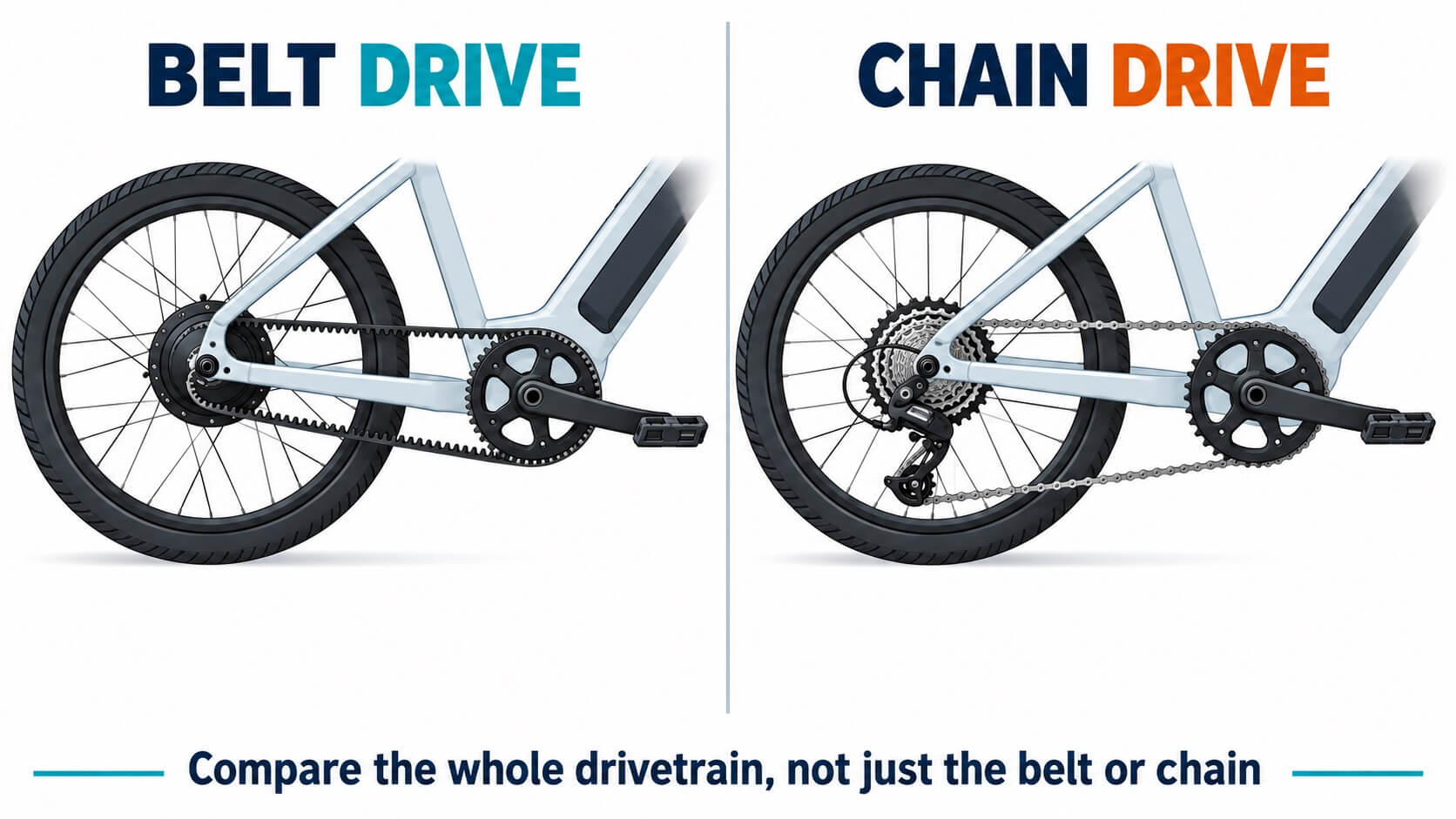
What changes when you choose belt or chain?
| Decision | Belt-drive bike | Chain-drive bike |
|---|---|---|
| Routine drive care | Follow the belt system’s cleaning, inspection, alignment and tension instructions | Follow the chain system’s cleaning, lubrication and wear-inspection instructions |
| Gear selection | Check the actual single-speed, geared-hub or gearbox arrangement | Can use a derailleur or an internal gearing arrangement; inspect the exact bike |
| Replacement | Identify the correct belt profile, length and approved sprockets | Identify the correct chain, connector and drivetrain compatibility |
| Service access | Confirm a workshop can support the belt and the hub/gearbox | Confirm support for the particular chain, gearing and motor system |
| Ownership cost | Quote the whole system, including specialised labour where required | Include consumables, wear parts and labour—not just a chain price |
This is a complete-bike purchase decision. Our separate e-bike chain cleaning and lubrication guide covers routine chain care; the comparison here explains what to establish before choosing a drivetrain.
Low maintenance does not mean no maintenance
Belt-drive ownership
For Gates-equipped bikes, obtain the current owner instructions for the specific bicycle and belt system. Gates’ bicycle belt resources provide product and application background. Correct handling and tension matter. Do not transfer a tension value or adjustment procedure from a different bike just because both belts carry the same brand name.
TENWAYS’ maintenance guidance for its Gates-equipped bikes says not to apply oil or paste to the drive and calls for removing obstructing debris. That does not make every part of the bicycle lubrication-free. The hub, bearings and other assemblies have their own instructions. If a belt becomes noisy or runs abnormally, identify the cause rather than adding chain oil to mask it.
Chain-drive ownership
Park Tool’s chain-care guidance includes checking wear, cleaning and lubricating a serviceable chain. Use products and procedures suitable for the drivetrain and conditions. A visibly clean chain is not proof that it remains within its wear limit. Keep cleaners and lubricant away from braking surfaces, and follow the bike manufacturer’s safe handling instructions.
For either choice, maintenance effort depends on use. A sheltered short commute and daily exposure to grit are different operating conditions. Build inspections around the manual and observed condition; do not buy on an invented “replace every X kilometres” rule. Our maintenance schedule guide explains that approach.
Gearing matters more than the belt-versus-chain label
A conventional bicycle belt runs between aligned sprockets; it is not moved across a derailleur cassette like a chain. Multi-gear belt bikes therefore need a suitable hub, gearbox or other manufacturer-designed arrangement. A single-speed belt bike and a multi-gear belt bike can have quite different uses.
Ask to test an ordinary start and a representative hill in the available gears. If the lowest gear asks more of your legs than you can comfortably sustain, a cleaner drivetrain does not solve that mismatch. Conversely, extra gears are not valuable if the bike’s overall setup is unsuitable or difficult for you to operate.
Do not assume all internal hubs shift the same way under load or at a stop. Ask for a demonstration and follow the hub or gearbox instructions. Similarly, confirm the approved shifting technique for a chain-equipped e-bike rather than forcing a change under high assistance.
Confirm the belt system is approved for the application
Gates publishes application-specific product guidance. Its product-line brochure distinguishes systems and sets conditions involving drive type and application. The practical lesson is that a branded belt alone does not prove suitability for any motor torque, cargo load or riding category. Have the bicycle supplier identify the complete approved configuration.
For an existing bike, conversion is a separate engineering question. Frame layout, belt installation access, alignment, tension adjustment, sprockets and gearing all matter. Do not cut or modify a frame to make a belt fit. If the original manufacturer does not support a conversion, compare purpose-built complete bikes instead.
Compare a written ownership-cost quote
There is no defensible universal payback mileage without comparable component life and labour data. Ask the local workshop for model-specific prices, then separate known costs from unknown replacement timing.
| Cost to request | What the quotation should identify |
|---|---|
| Purchase price | Complete bike, exact gearing and included equipment |
| Routine service | Tasks, labour rate and manufacturer-required hub/gearbox service |
| Wear-part replacement | Belt plus relevant sprockets, or chain plus relevant gearing components, as inspection requires |
| Wheel or tyre work | Labour for the actual axle, drive and electrical arrangement |
| Downtime | Current parts availability and repair route, clearly distinguished from a guaranteed turnaround |
Illustrative decision: a commuter who dislikes routine chain cleaning may willingly pay more for a belt bike with suitable gearing and a nearby specialist. A rider travelling where the specific belt or hub cannot readily be serviced may prefer a supported chain system. Neither scenario establishes an industry-wide cost winner. Use your actual route and repair access.
Five questions to settle before ordering
- What exactly is fitted? Record belt or chain identification, sprockets, hub/gearbox or derailleur, and the model revision.
- Does the gearing fit my route? Test starts and climbing at a comfortable effort instead of relying only on motor wattage.
- Who will service it? Name the workshop and confirm which assemblies it supports.
- How are replacement parts identified? Ask for a parts reference and an order route, not a promise that anything of the same size fits.
- What does the warranty exclude? Separate wear, adjustment, damage and manufacturing defects in the applicable written policy.
If motor output is part of your comparison, the motor wattage guide helps distinguish rated and peak figures. It does not replace drivetrain compatibility approval.
Frequently asked questions
Is belt drive better for commuting?
It can be a good fit where its gearing works for the route and support is available. The reduction in routine chain lubrication is useful, but fit, brakes, tyres, load limits and service access still decide whether the whole bike is suitable.
How long does a belt last compared with a chain?
There is no single service life that applies to every model and rider. Ask for the manufacturer’s inspection and replacement criteria. Treat mileage or multiplier claims as conditional unless their test conditions match the question you are asking.
Is a belt-drive e-bike silent?
Do not buy on a silence guarantee. Tyres, motor, hub and other parts still make sound. New or unusual drive noise calls for inspection under the manufacturer’s procedure.
Can a belt be repaired like a chain at the roadside?
Do not assume it can be joined with a chain-style connector. Follow the belt manufacturer’s handling and replacement instructions. Even a chain repair requires compatible parts and correct technique; plan a recovery option if you cannot safely restore the bike.
What should an importer specify?
Define the route, expected load, service network and acceptable maintenance tasks, then request the complete drive specification and application evidence. Our procurement guide covers the broader evidence and purchasing process.
Next step: test suitable complete bikes and obtain a parts-and-service quotation for each. Choose the system you can ride comfortably and maintain locally, not the one with the longest unsupported lifespan claim.
Sources checked 21 September 2026. The buyer worksheet and scenarios are decision aids, not Jimsen durability testing or guaranteed ownership costs.