
Removable vs Fixed E-Bike Batteries: Integrated Does Not Mean Non-Removable
Choose a rider-removable battery if you need to charge separately from the bicycle or regularly carry the bike without its battery weight. A fixed battery can work when you have a suitable place to charge the whole bicycle and an identified replacement-service route. “Integrated” only describes how the battery fits into the bicycle. An integrated battery may still be removable. Before buying, ask the seller to demonstrate the exact model’s removal, charging and refitting procedure.
This is a purchase comparison, not a battery-removal tutorial. Follow the bicycle’s instructions; do not open a pack or remove structural parts to imitate another model’s design.
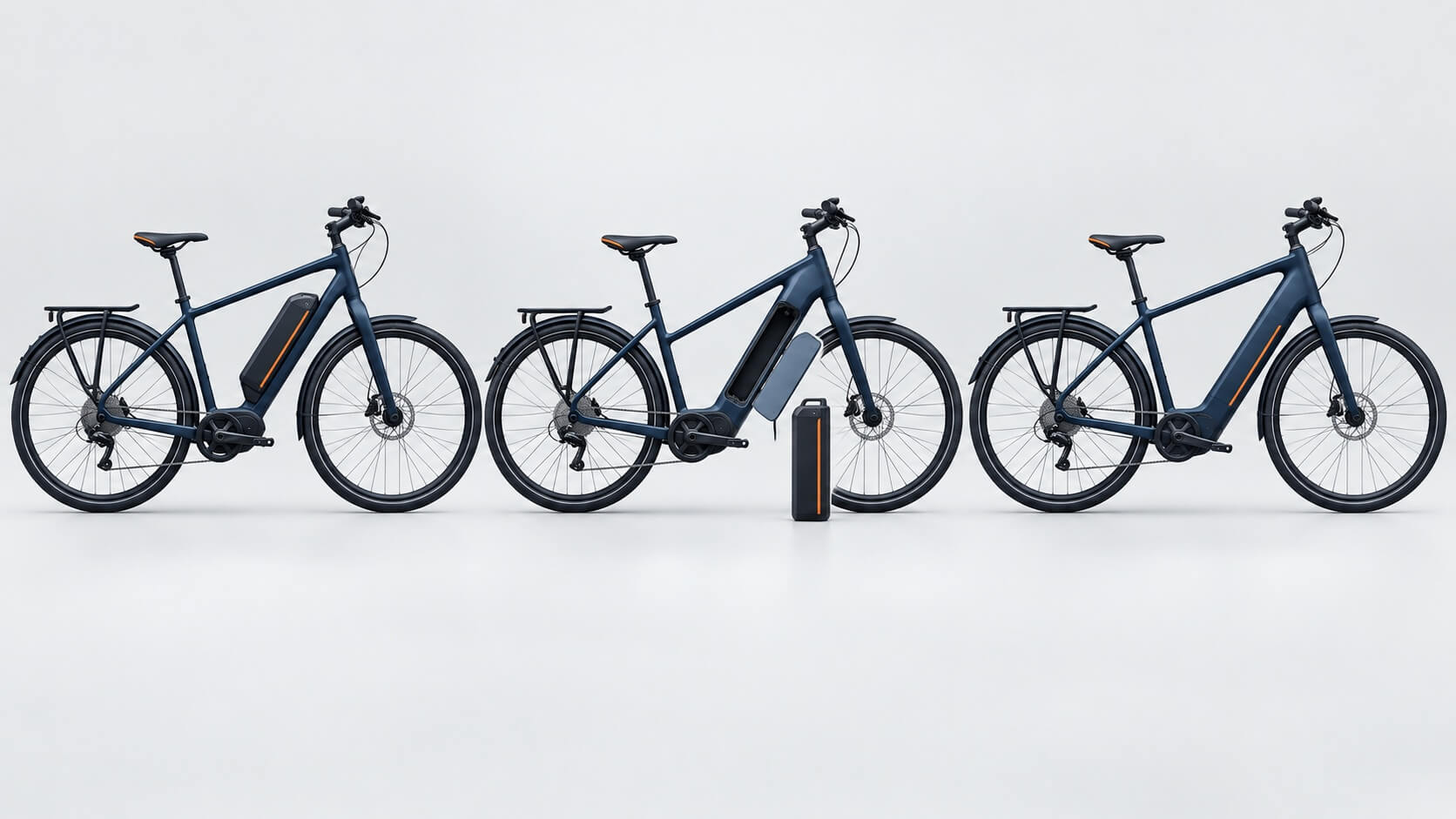
Compare three arrangements, not two labels
| Arrangement | What it means | Check before ordering |
|---|---|---|
| External, rider-removable | A visible pack is designed to be detached by the owner | Lock, lifting grip, removal direction and approved off-bike charging |
| Integrated, rider-removable | The pack sits within the frame but has an owner-accessible removal system | Cover, safety restraint, extraction clearance and secure refitting |
| Fixed for everyday use | The owner is not expected to remove it for normal charging or storage | Whole-bike charging location and an authorised service replacement process |
“Fixed” should not be read as “the battery can never be replaced.” Nor does “replaceable” establish that you can remove it daily. Ask who performs the replacement, what must be dismantled, what parts are required and whether the service is available locally.
A documented example of integrated removal is the Bosch PowerTube 750 MY2022 manual. It describes pivot and axial removal arrangements. Those procedures differ, even within that named product family. The example establishes why you need the bicycle’s actual manual; it is not a removal instruction for every integrated battery.
Begin with where you will charge
Imagine returning home with the complete bicycle. Can it reach a permitted, suitable charging position without blocking access? Is the socket usable without an improvised electrical arrangement? Does the building permit the bicycle and the proposed charging location? If the answer is no, the attractiveness of a concealed battery will not fix the daily problem.
A removable pack may let you bring only the battery to an approved charging location. Confirm that the manufacturer permits off-bike charging and that you can carry the pack securely. You still need to follow temperature, charger and fire-safety instructions. Removability is a convenience feature, not a declaration that charging anywhere indoors is safe.
Our charging-time guide helps plan an attended session. The charger compatibility guide explains why voltage labels and connector shape alone do not approve a replacement charger.
Test the removal space with normal accessories fitted
Ask the dealer to demonstrate on the exact bicycle and frame size you intend to buy. Watch the whole movement: where the key goes, how the cover opens, how the pack is supported and which direction it exits. A frame bag, bottle cage or other accessory may affect access. Do not accept a demonstration on a different frame as proof that yours works the same way.
Then try the permitted owner procedure yourself under supervision. Can you reach the latch and support the pack without dropping it? Can you see that it is secured when refitted? If the movement is awkward, ask whether another frame or battery arrangement is more suitable. Forcing a cover or relying on a partial latch is not a workaround.
Record the key or lock service arrangements as instructed by the seller. Ask how a replacement key is obtained and what to do if the mechanism is damaged. Keep identifying information securely rather than publishing it in a product review or social-media photo.
Compare weight honestly
Use the complete bicycle weight in the condition you will actually handle. A “without battery” specification only helps if removing it is permitted and practical for that journey. If you must carry both bicycle and battery upstairs, separating the load does not make either item disappear.
For example, if a hypothetical bicycle weighs 24 kg with a 3 kg removable battery, the bicycle portion is 21 kg after removal, while you still have the separate 3 kg pack to transport. This is arithmetic, not a Jimsen model specification or a safe lifting limit. Check your own ability and the route rather than assuming the reduced number is manageable.
For car transport, follow the bicycle and rack instructions. Do not infer that every integrated battery must remain installed, or that every removable battery must be detached, without reading the applicable instructions. The storage and protection of a detached pack also need an appropriate plan.
Security and weather: ask for documented limits
Ask what the battery lock secures and how the complete bike should be locked. Removing a pack may be part of a practical theft-deterrence routine, but it does not secure the remaining bicycle. A hidden battery is not proof of theft resistance.
For rain, cleaning and storage, use the exact model’s instructions. A closed-looking frame does not establish the battery system’s water protection. Covers, drains, charging-port protection and connectors have specific requirements. Do not direct high-pressure water at a battery compartment or improvise a sealant repair.
If a pack has been dropped, damaged or begins showing signs of failure, stop using and charging it and seek qualified support. London Fire Brigade identifies abnormal heat, swelling, leaks and unusual smells or sounds as warning signs. Removable and fixed designs both require an appropriate response; do not dismantle the bicycle around a failing battery.
Get a replacement route before it becomes urgent
Ask the seller for the approved battery part number, system generation and a current installed-replacement quote. The quote should separate the pack, required covers or fittings, labour and any diagnostic work. Ask where the work takes place and what happens if the original version is discontinued.
Do not assume that a pack with the same nominal voltage will work. Physical fit, mounting, electrical compatibility and system communication may differ. A removable battery is not necessarily interchangeable between bikes, even when it looks similar. If a seller cannot identify an approved replacement route, that uncertainty belongs in the buying decision.
For a used bicycle, combine these questions with our battery-health checks. Accessibility and remaining condition are separate issues. For extended non-use, follow the battery-storage guide and the model’s own limits.
Questions to settle at the shop
- Is this pack designed for everyday owner removal or workshop removal?
- Can it be charged on and off this exact bicycle, and under what instructions?
- Can I demonstrate safe removal and secure refitting with my accessories installed?
- What is the ready-to-carry weight in each permitted configuration?
- Who supplies and installs the approved replacement, and what does the present quote include?
Common questions
Is an integrated battery always fixed?
No. Integrated describes its placement. Some systems have an owner-operated release, while others require workshop access.
Does an external battery last longer?
Location alone does not establish lifespan. Compare the battery specification, usage instructions, condition and replacement support rather than making an age prediction from its appearance.
Should I choose removable if I live upstairs?
It is worth checking, but test the actual carrying and charging arrangement. You may still need to move a heavy bicycle, and your building’s rules still apply.
Which should a dealer specify for a new product line?
Define the customer’s charging location, lifting needs, accessory clearance and local service route first. For a Jimsen project, send those requirements through the OEM/ODM enquiry page and ask for a proposed configuration to evaluate. Do not specify “integrated” as if it answered every access and service question.