
How to Store an E-Bike in an Apartment: Space, Stairs and Charging
Plan an e-bike’s route into the building, its parking position and its charging arrangement before buying a storage rack. Confirm your building’s rules, keep escape routes clear and measure doors, turns and lift space. Choose a support rated for the exact bicycle and installed as instructed. If carrying the bike upstairs is unsafe or permitted charging cannot be arranged, a smaller footprint alone will not solve the problem.
This guide concerns everyday whole-bicycle storage. For charge state and temperature during weeks or months without riding, use our separate e-bike battery storage guide. Local fire guidance, the building’s policy and the bicycle manual take priority over general layout ideas.
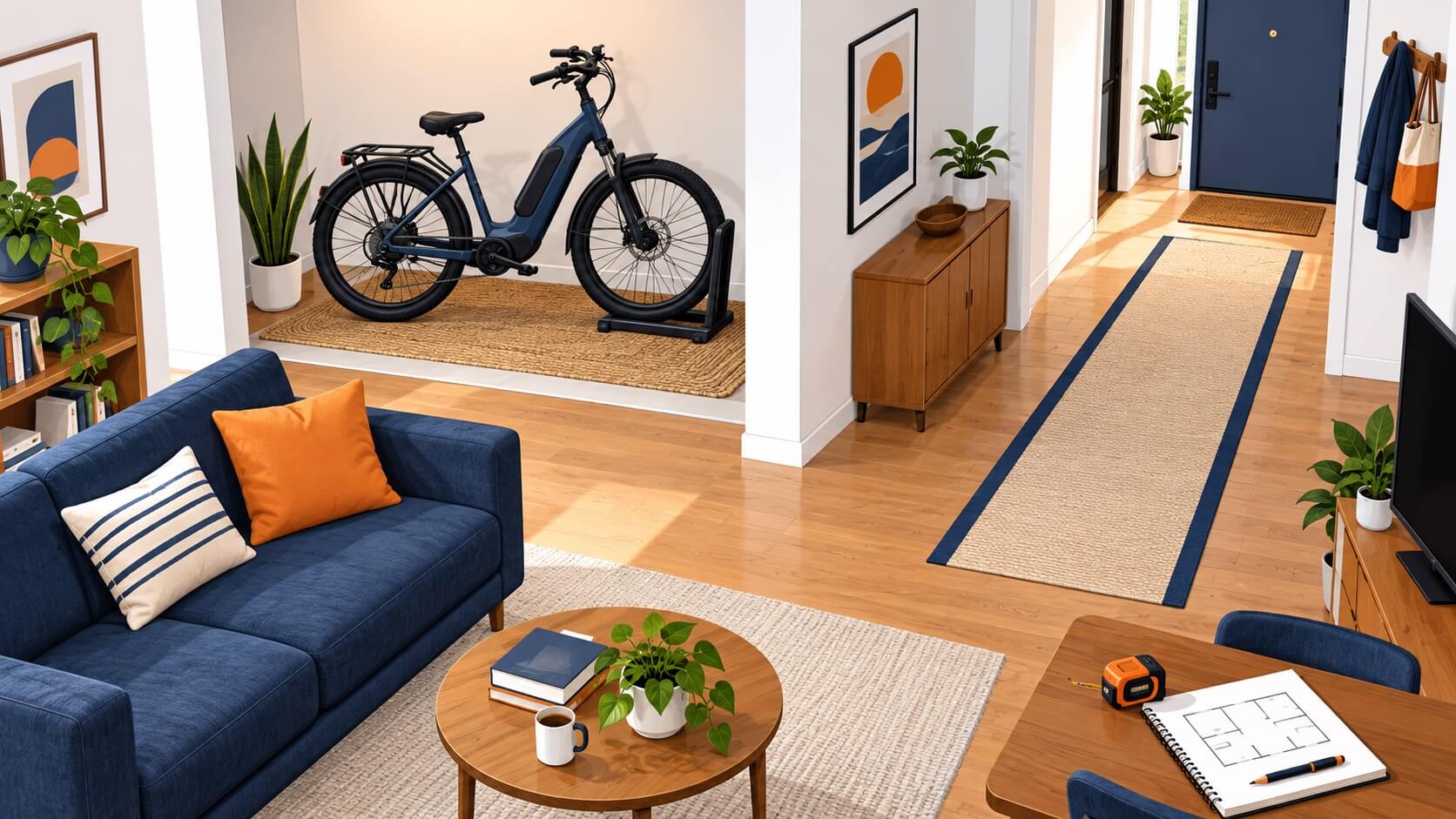
Ask the building manager before choosing a spot
Check the tenancy or building policy for e-bikes, removable batteries, charging, communal rooms and use of lifts. Ask for the current rule in writing. Permission to store an ordinary bicycle does not necessarily cover an electric one, and permission to store a bike does not automatically include charging it.
Do not use a communal corridor, stair landing or space in front of a fire door as an improvised parking bay. London Fire Brigade’s guidance for building managers explains that a battery fire in a corridor or stairwell can block escape. Its legal references concern its jurisdiction; ask the responsible local authority or building manager about the rules where you live.
Agree who to contact if the charging facility is unavailable or the bicycle develops a battery fault. Planning an alternative in advance is better than leaving a questionable pack in a shared space while you work out what to do.
Measure the entire journey from the street
Record the bicycle’s length, handlebar width and relevant height with its actual accessories. Include baskets, mirrors, panniers and any child seat. Then walk the route from the entrance to the intended parking space, taking measurements at the difficult points.
| Place | Measure or demonstrate | Reason to reject the arrangement |
|---|---|---|
| Entrance and flat door | Usable opening with the door held normally; handlebar clearance | Bike catches the frame or requires an unsafe lift |
| Corner or landing | Space to turn the complete bike, including accessories | You must leave it obstructing the shared route |
| Lift | Opening, cabin space and applicable building rules | It cannot fit without damaging the bike or blocking safe use |
| Stairs | A safe handling plan for the real carrying weight | You cannot control the load or keep your footing |
| Parking bay | Footprint plus room to move, remove a battery and open doors | It interferes with an exit, heater or required access |
As a layout example, a 70 cm handlebar passing through an 80 cm opening has only 10 cm of total nominal clearance when held square. Door hardware, hand position and accessories can reduce it. This subtraction is a screening calculation, not a safe-clearance standard. Try the actual bicycle with help, or make a full-size mock-up before spending money.
Choose floor, wall or folded storage for the real load
Floor-level storage
A suitable floor stand avoids lifting a heavy bicycle onto a hook. Check tyre width, wheel size, stability and whether the support contacts any electrical or brake component. The stand must hold the bike with the accessories you leave attached. Keep the area tidy so that a cable, bag or mat does not create a trip hazard.
Wall or vertical storage
Check the rack’s rating and bicycle compatibility, then have a competent installer assess the wall, fixings and required permissions. A quoted rack capacity does not establish that a plasterboard wall and arbitrary screws can carry it. Avoid generic instructions that specify a fixing without knowing the wall construction.
Test the lifting movement before committing. Confirm that the bicycle manufacturer permits the proposed orientation and contact points, and that brake hoses, suspension parts and the battery are not loaded or trapped. Do not hang the bike by a battery handle, cable or component that was not designed for support.
Folding storage
A folder may reduce the footprint, but it can still be heavy. Compare the folded envelope and carrying weight with the exact cupboard or alcove. Model-specific rolling or upright-parking features require their own instructions. A storage cover protects surfaces; it is not evidence of fire containment or a safe place to charge.
Stairs can be the decisive buying constraint
Count the flights and note turns, slippery surfaces and doors you must operate while handling the bicycle. Ask the dealer to demonstrate approved lifting points and whether the battery can be removed for handling. Battery removal may reduce one load, but you must still transport both items safely.
If the bicycle is beyond your ability to lift and control, do not make an improvised ramp or use motor assistance to propel it up stairs. Consider an approved ground-floor storage area, a lighter suitable model or another transport option. Ask for help assessing the task rather than testing your limit on a staircase.
Keep the manual’s removal and installation procedure available. After moving a removable battery, confirm it is secure before riding. Any damaged mounting or connector needs assessment; forcing the latch is not a solution.
Make a separate charging plan
London Fire Brigade’s charging advice recommends the correct charger, avoiding charging while asleep or away, and keeping exits clear. Follow the battery and charger instructions, use an approved location and disconnect when charging is complete. Use a hard, flat charging surface where heat can dissipate.
Check the route of the mains lead and whether the manufacturer allows the proposed electrical arrangement. Do not improvise damaged plugs, adapters or a charger chosen only because its connector fits. Our charger compatibility guide explains the checks behind a replacement charger.
A removable battery can allow charging separately from the bike where the manufacturer and building policy permit it. It does not make an unsuitable room safe. Use the charging-time guide to plan an attended session; calculated hours do not override the charger’s indicators or manual.
If the battery is swollen, damaged, leaking, producing an unusual smell or becoming abnormally hot, stop using and charging it and seek manufacturer or qualified support. These are among the warning signs identified by London Fire Brigade. If it smokes or catches fire, get out, raise the alarm and contact local emergency services; do not tackle the fire yourself. Do not carry a failing battery through the building or attempt to open it.
Security and cleanliness without creating new hazards
A shared bicycle room still needs a security plan. Check the building’s authorised anchoring points, access control and your insurance conditions. Record the frame serial number and keep proof of purchase. Do not attach a lock or support to fire-service equipment, railings needed for access or fixtures not intended for the load.
Let the bike dry as instructed before storage. A simple floor protector can help with dirt if it stays flat and does not obstruct the route. Keep brake surfaces free of oil and cleaning products. Our safe cleaning guide covers the bicycle; do not hose it down in an apartment or near charging equipment.
Before you buy a rack or a bicycle
Complete an access and storage check with the building manager and seller. Bring the bicycle dimensions, ready-to-carry weight, battery-removal procedure and a sketch of the route. Ask them to identify an allowed parking/charging arrangement and demonstrate handling. If the arrangement fails one of those checks, change it before ordering.
Common apartment-storage questions
Can I keep an e-bike inside my flat?
That depends on the building’s rules, local requirements, battery condition and a suitable storage/charging arrangement. Indoor storage is not a blanket permission to charge in any room.
Is a fireproof bag enough?
Do not treat a product label or cover as a substitute for the manufacturer’s instructions and fire-safety guidance. It does not establish that a blocked exit or unsuitable charging spot is safe.
Can I hang an e-bike vertically?
Only with a compatible support, verified installation and a bicycle approved for that position. Confirm the complete load and whether you can lift it safely.
What if I cannot carry it upstairs?
Find an authorised ground-floor solution or choose a bike you can handle. A folding joint reduces dimensions; it does not guarantee an acceptable carrying weight.