
Hydraulic vs Mechanical Disc Brakes on E-Bikes: A Buyer’s Guide
Hydraulic disc brakes are often worth considering when frequent stops, hills or hand fatigue make controlled lever effort a priority. Mechanical disc brakes can suit a bicycle designed for them when you can maintain cable and pad adjustment. Neither label proves that a particular e-bike will stop well. Compare the complete brake system, the bicycle’s permitted use and load, and the local service options. Do not buy or upgrade on the word “hydraulic” alone.
This is a selection guide, not an installation or bleeding procedure. Jimsen has not carried out a head-to-head stopping-distance test for this article. Model examples below explain design differences and do not certify suitability for your bicycle.
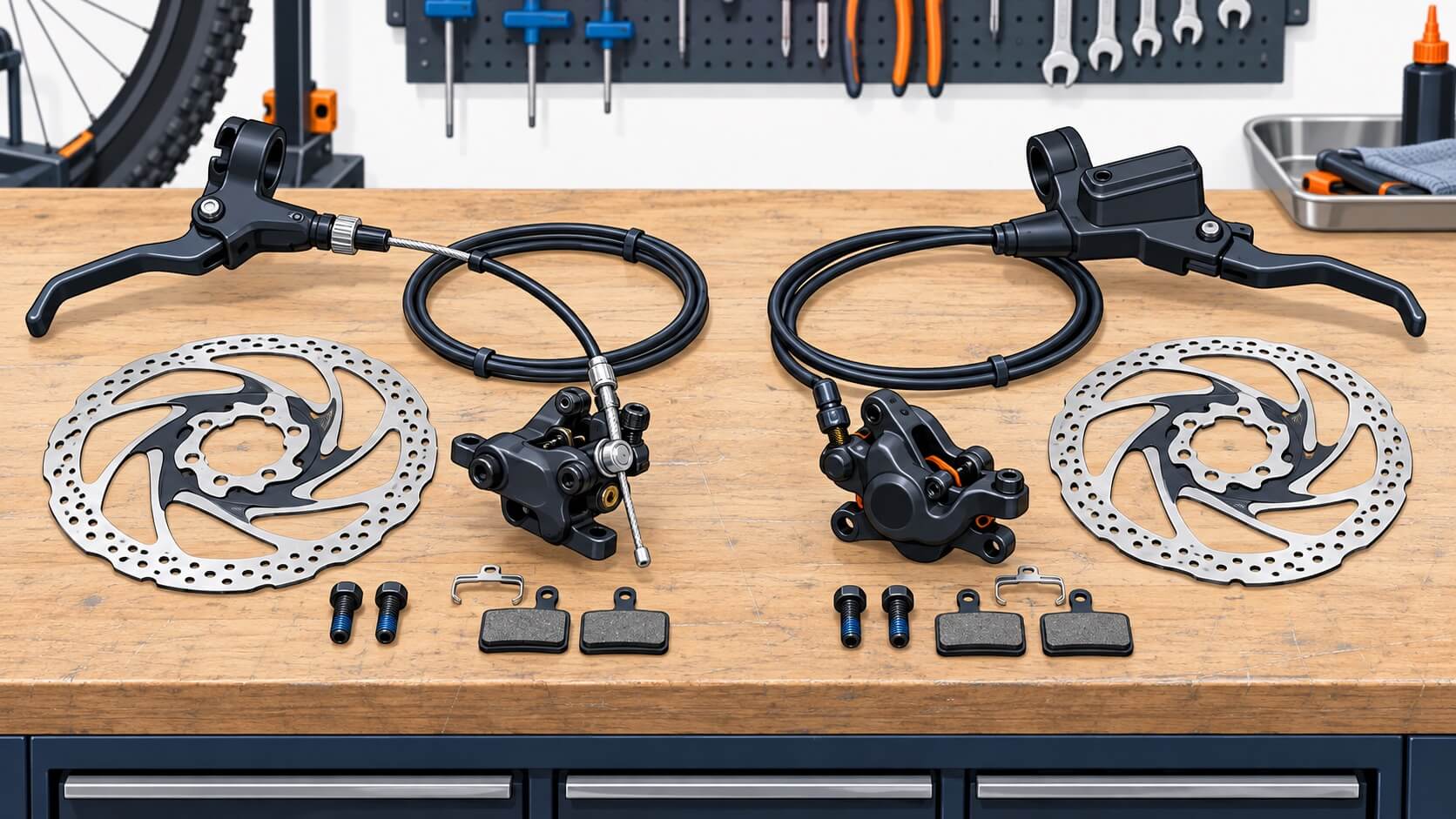
What changes between the two systems?
A mechanical disc brake transmits force from the lever through a cable to a caliper. A hydraulic brake transmits pressure through fluid in a hose. Both press pads against a rotor at the wheel. The rotor, pads, lever geometry and setup affect the result in either system. Aventon’s brake comparison explains the two actuation methods and their service differences.
| Buying question | Mechanical disc | Hydraulic disc |
|---|---|---|
| How does the lever operate the brake? | Cable moves the caliper mechanism | Fluid pressure moves the caliper pistons |
| What changes as parts wear? | Pad clearance and cable adjustment require attention according to the design | Many systems compensate for pad wear; pads, rotors and fluid still need inspection/service |
| What affects lever feel? | Cable friction, housing, adjustment and lever/caliper compatibility | Lever design, reach adjustment, air/leaks and the condition of the system |
| What should the workshop support? | The specified cable, housing, pads and adjustment procedure | The exact fluid, fittings, bleed procedure and replacement parts |
| What does the label not establish? | Stopping distance, maximum load or adequacy for a long descent | The same: hydraulic actuation is not a complete performance specification |
Mechanical does not always mean one moving pad
Some cable-operated calipers move one pad toward a fixed pad; others move both. The TRP Spyke is a documented dual-sided mechanical example with independent pad adjustment. TRP specifies linear-pull levers for it. That example matters because “all mechanical brakes use one piston” is an unreliable buying shortcut.
It also shows why you need the model number. A lever that pulls the wrong amount of cable is not made compatible by using a more expensive cable. Ask the bicycle manufacturer or workshop to confirm the approved combination. Follow the exact model’s instructions for cable, housing and adjustment requirements.
Why load and hills change the questions you should ask
A heavier bicycle and load require more energy to be dissipated during a stop at the same speed. Repeated braking on a descent adds a heat-management question. The relevant comparison is therefore the whole bicycle in its intended conditions, including rotor and pad specification, rather than two calipers photographed on a bench.
Tell the seller your rider and cargo load, normal gradients and whether you stop often. Ask for the permitted total load, intended-use category and installed front/rear brake models. A cargo rack’s load rating does not by itself prove that the bicycle’s complete configuration is suitable for that cargo.
The simple physics also explains why speed deserves attention: kinetic energy is proportional to mass and to speed squared. In an idealised comparison at the same mass, increasing speed from 20 to 30 km/h increases kinetic energy by 30²/20² = 2.25 times. That is not a prediction of stopping distance or brake temperature. Road grip, technique and the brake system affect a real stop.
Compare control and maintenance on the actual bikes
During a shop-supervised test ride in a safe area, check whether you can reach both levers and apply the brakes progressively while maintaining a secure grip. Ask the shop to set lever reach within its supported range. Hand size and the shape of a lever can matter as much as the broad brake category.
A lever that pulls toward the handlebar, a visible fluid leak, frayed cable, damaged rotor or markedly weak braking is a fault to investigate, not a normal trade-off to accept. Stop riding and obtain a qualified inspection if braking is unreliable. Do not perform a high-speed or steep-hill test to “prove” a questionable system.
Both systems consume pads. The appropriate replacement point comes from the brake manufacturer’s wear limits, not a shared mileage interval. Our brake-pad inspection guide covers warning signs and model-specific limits. Put those checks into your e-bike maintenance plan.
Hydraulic service needs the exact fluid specification
Do not identify brake fluid from the bicycle brand or assume that all systems from one component brand use the same fluid. SRAM documents both DOT-fluid and mineral-oil systems. Its Road AXS and XPLR AXS manual separates the two and requires the specified fluid for each; the Maxima Mineral Brake Oil page gives a mineral-oil application example.
Using the wrong fluid can damage the system. Bleeding also requires the correct kit and procedure. Ask which workshop can service the fitted model, and obtain a quote that states what is included. Do not top up an unidentified system or mix products because their bottles look similar.
Keep oil and cleaning products away from pad and rotor friction surfaces. If contamination is suspected, follow the manufacturer’s service instructions or have the workshop assess it. Do not use heating, sanding or household solvents as a universal cure. Our e-bike cleaning guide explains how to separate drivetrain cleaning from the brake area.
Should you upgrade an existing e-bike?
First establish whether the current brake needs ordinary service. A poorly adjusted cable system should not be compared with a new, correctly set-up hydraulic one as if the difference were all design. If the original system is unsuitable for your approved use or you cannot operate it comfortably, ask for a documented upgrade assessment.
The workshop should check frame/fork mounts and rotor limits, lever and caliper compatibility, hose/cable routing, pad and rotor pairing, and any electrical brake cut-off switch. An e-bike may integrate a sensor into a lever; a replacement that fits the handlebar can still omit that required function. A larger rotor is not automatically approved for the fork or frame.
Request a complete installed quote, including compatible parts, setup and the manufacturer’s bedding-in process. Compare that cost with a bicycle already configured for your intended use. This article does not specify a universal rotor size or upgrade kit.
A shortlist you can take to a dealer
- List the actual route, rider/cargo load and any difficulty gripping a lever.
- Record front/rear brake, lever, rotor and pad models on each candidate bicycle.
- Ask the workshop which routine checks you can do and which service requires booking.
- Confirm local availability of the exact pads and other service parts.
- Test control on the correctly adjusted bicycle before deciding.
For an OEM/ODM project, provide the target market, intended vehicle/load and riding conditions through Jimsen’s configuration enquiry. Request a proposed braking specification and validation requirements. A component label alone is not a substitute for confirming the final vehicle configuration.
Common questions
Are hydraulic brakes maintenance-free?
No. Pads and rotors wear; hoses, fittings and fluid need the checks and service required by the model. Automatic pad compensation, where provided, does not remove inspection duties.
Are mechanical disc brakes unsafe on every e-bike?
No. Suitability depends on the bicycle’s design, approved use and load, installed system and condition. Do not accept a sweeping claim that either brake type is safe or unsafe without those details.
Can I compare brakes by piston count?
Piston count is one construction detail. It does not establish lever effort, heat capacity or stopping distance on its own. Compare the complete specified system and the manufacturer’s permitted application.
Which option is cheaper over time?
Obtain local parts and labour quotes for the exact systems. Riding conditions and service needs vary, so there is no supported universal annual saving in this guide.