
Step-Through vs Step-Over E-Bikes: Choose for Access, Fit and Use
Choose a step-through e-bike if a lower opening makes mounting and stopping easier for you; choose a step-over if you comfortably clear its higher top tube and the complete bike suits your riding. Frame shape alone does not establish strength, rider size, load capacity or off-road suitability. Compare the exact models’ geometry, rated use and permitted loads, then test everyday movements. Neither shape is reserved for a gender or age group. A bike that is easy to mount can still be too long, too heavy or awkward to store.
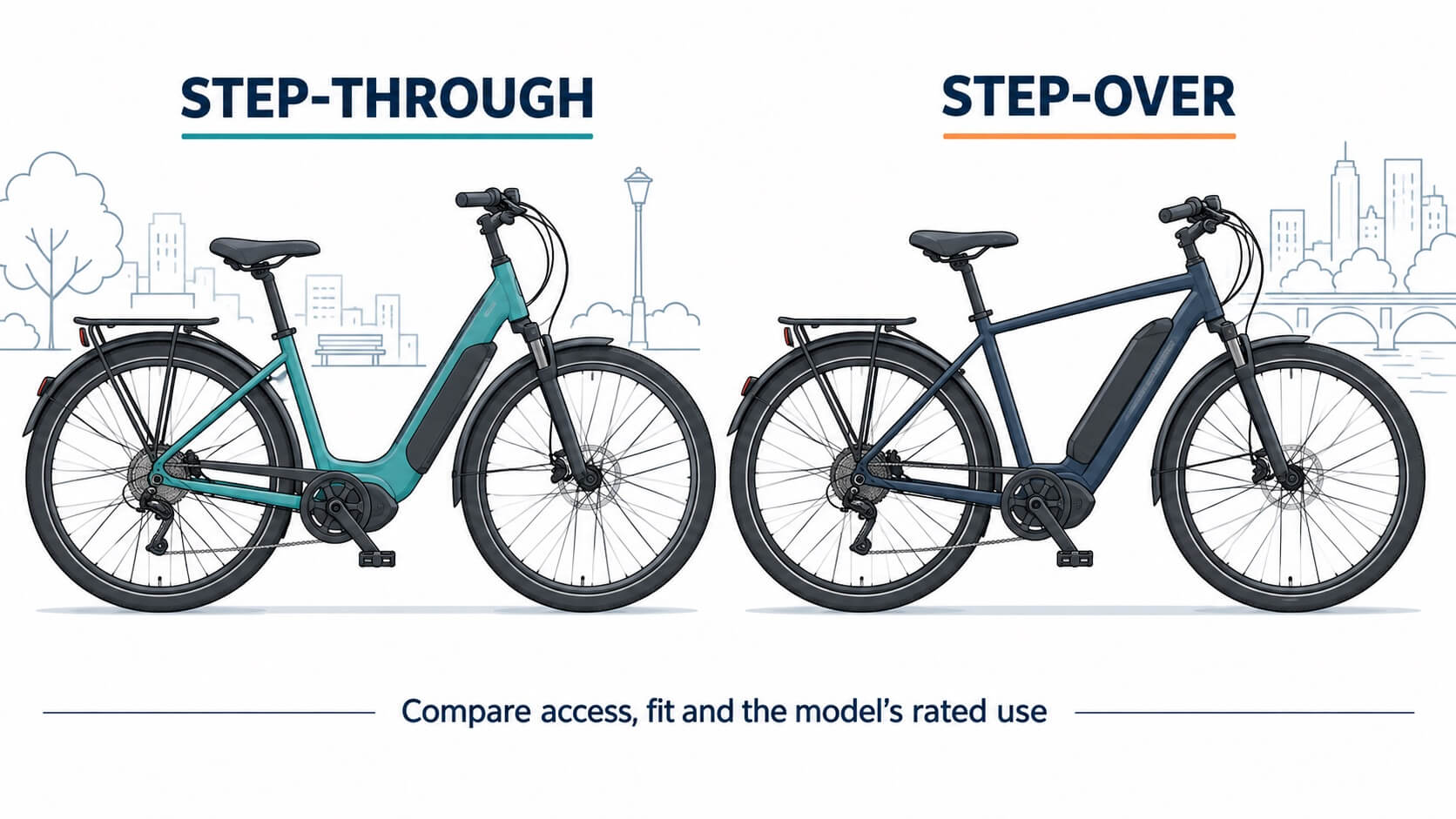
What the two names mean
A step-through frame has a low or absent top tube that creates a more accessible opening. A step-over frame has a higher top tube. Some manufacturers also use terms such as low-step, stagger or mid-step for intermediate shapes. Those names are not standard measurements: inspect the geometry and the bike itself.
Manufacturer comparisons from Aventon and EVELO explain the access difference. Their examples concern their own products. Do not turn a general comparison into a claim that every high-tube bike carries more weight or every low-step bike has an upright fit.
Compare the tasks, not the stereotype
| Your task | Why a step-through may help | What still needs checking on either frame |
|---|---|---|
| Frequent stops and errands | Less top-tube clearance needed when getting on and off | Balance, brakes, saddle setup and controlled starting |
| A rear bag or approved child seat | A front opening can avoid swinging a leg over the rear load | Approved accessories, load limits and safe mounting with that setup |
| Clothing that restricts leg movement | The low opening can make access less awkward | Clearance from chain, wheels and other moving parts |
| Sport or rough-surface riding | Access remains a personal consideration | The specific bike’s intended-use category, components and manufacturer limits |
| Car transport | No automatic advantage | Rack approval, wheel fit, clamping location and actual bike weight |
| Apartment storage | No automatic advantage | Overall dimensions, turning space and whether you can safely move it |
Easy access is not the same as correct size
A low opening answers “Can I get through the frame?” It does not answer “Can I reach the handlebar comfortably?” Ask to adjust the demonstration bike within its approved limits before deciding. Riding with an unsuitable saddle position to compensate for excessive reach is not a successful fit.
Compare these separately:
- Mounting clearance: the space your foot and leg need to pass through or over the frame.
- Standing clearance: the clearance available when you stand over the bike where you normally stop.
- Seated reach: whether you can hold the bars and operate the brakes without stretching or locking your arms.
- Adjustment range: whether the saddle and permitted cockpit adjustments accommodate you without exceeding insertion marks or other limits.
A height chart is a starting filter, not a guarantee. Two riders of the same height can have different proportions and movement preferences. For a remote purchase, ask the seller to identify the actual frame size and provide the geometry and return terms before payment.
Are step-through frames weaker?
You cannot determine the safe load or intended terrain from the outline alone. The relevant purchasing evidence is the manufacturer’s rating for the exact model and configuration. Material, tube dimensions, joints and the rest of the design are not visible in a simple silhouette. Do not use an attractive frame photo as structural evidence.
Ask for the maximum permitted system mass and its definition. Some figures include the bicycle as well as rider and luggage; a “payload” figure may be defined differently. Also check separate limits for the rack, seat or carrier. The largest headline number is not permission to put that amount on any one component.
Hypothetical example: if a manual defines a 150 kg maximum system mass including a 25 kg bicycle, it leaves 125 kg for everything else included in that definition. A 100 kg rider and 15 kg of luggage total 140 kg with the bike. That arithmetic passes the stated system limit, but it does not establish that the rack can carry 15 kg. Its own rating still has to pass. These are invented numbers to explain the calculation, not Jimsen model specifications.
A ten-minute fit and access check
Have the seller demonstrate safe operation first, in a suitable traffic-free area. Keep electrical assistance off for stationary mounting checks and follow the bike’s instructions when starting to ride.
- Mount from the side you normally use. Notice whether a bag, battery position or high rear accessory obstructs the movement.
- Stop and dismount several times. A single carefully arranged mount may conceal an awkward everyday movement.
- Reach both brake controls comfortably. Ask for approved adjustment if needed; do not accept a setup you cannot confidently operate.
- Walk and turn the bike. Include the narrow space you expect at home, using safe clearance rather than a forced manoeuvre.
- Check the intended luggage setup. Have the seller demonstrate an approved arrangement; do not improvise passenger or cargo loading.
- Inspect the charging and storage routine. Check whether the battery can be removed as instructed without an obstruction.
Record a pass, a specific adjustment needed or a failure for each task. If both frames pass, choose on ride feel, equipment and service support. If one repeatedly makes access difficult, a lower price does not remove that problem.
Two purchase situations that change the choice
Shopping and short trips
A rider making repeated stops may value an accessible opening more than the appearance of a traditional frame. The useful comparison is between complete bikes with the intended bag or carrier—not a bare bicycle against a loaded one. Check that parking and mounting remain manageable after the approved equipment is fitted.
Long rides and mixed surfaces
A rider comfortable on either frame should look next at fit, riding position, tyres, brakes and the manufacturer’s intended use. Do not reject a suitable low-step model simply because it is low-step, or take a city step-over onto technical trails because it has a top tube. For ongoing care, our maintenance planning guide explains how use and conditions change inspections.
Frequently asked questions
Are step-through e-bikes only for shorter riders?
No. Opening height and overall bike fit are separate. Check the sizes and geometry offered for the specific model.
Is step-over always lighter?
No universal weight difference should be assumed. Compare the actual bike size, battery and fitted equipment. Ask the seller to weigh the configuration you intend to buy when lifting matters.
Will a step-through fit my car rack?
Only if the rack manufacturer approves the complete fit. Check the weight, wheelbase, tyre width, attachment method and any approved adapters. A generic adapter is not automatic permission to suspend or clamp a heavy e-bike.
Does a low frame make riding safer?
It may make access easier for a particular rider, but it is not a blanket safety guarantee. Control, fit, maintenance, riding conditions and the bike’s limits still matter.
What should a dealer or importer specify?
Describe the intended rider range, mounting needs, load, terrain and accessory setup, then request model-specific geometry and verification evidence. Use our procurement guide to turn those needs into a documented specification rather than approving a frame solely from its shape.
Next step: take this checklist to a retailer and test both frame styles in the correct size. Ask for the geometry, permitted-load definitions and accessory approvals for the bike that passes.
Reviewed 21 September 2026. The calculation is illustrative; the checklist is a proposed buyer method, not a claim of Jimsen comparative testing.