
Torque Sensor vs Cadence Sensor E-Bikes: How to Choose
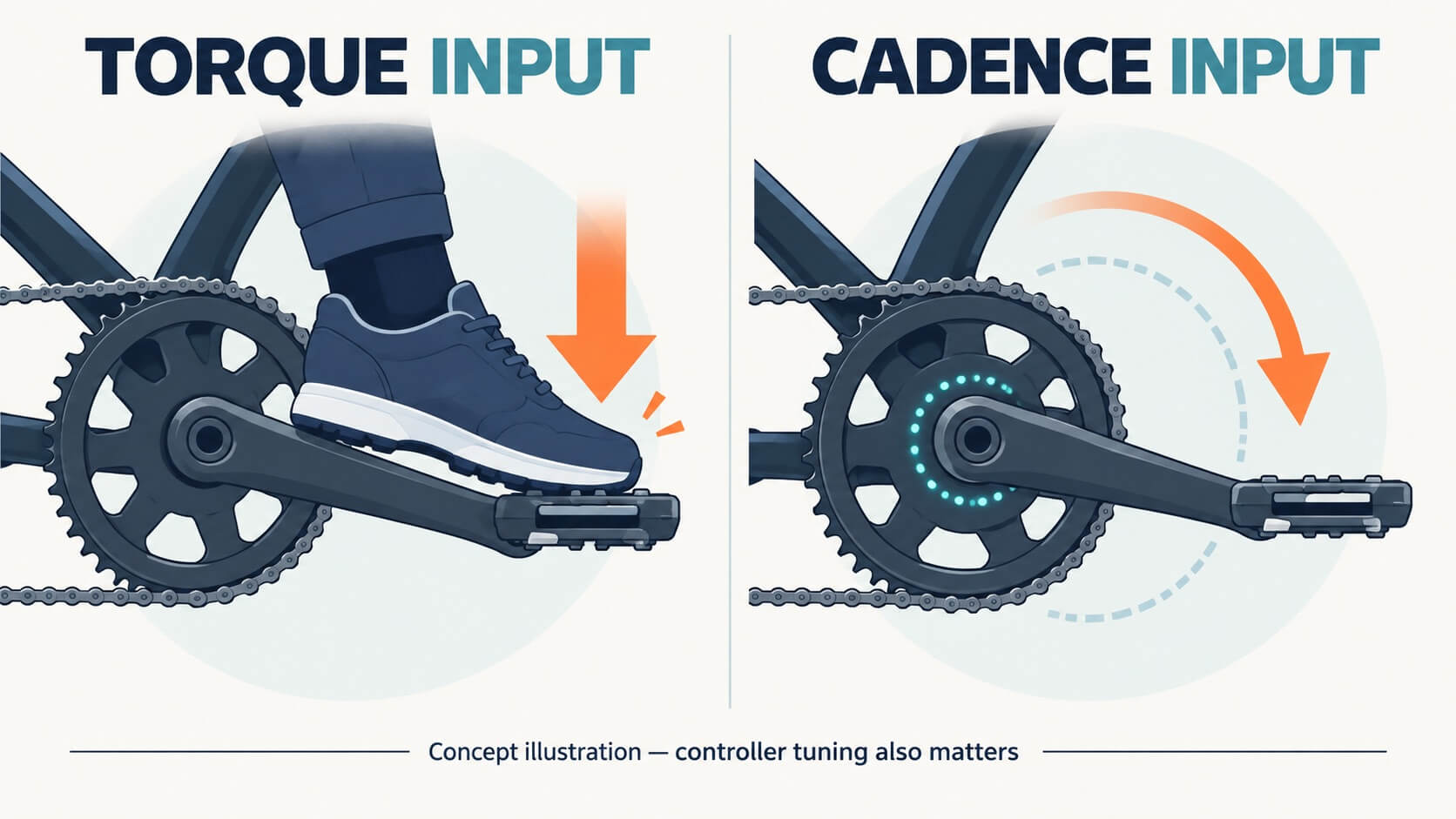
A torque sensor measures rider effort; a cadence sensor detects pedal rotation. Choose between complete bikes by how predictably their assistance responds to you, not by assuming one sensor guarantees a better ride. Torque-based assistance can suit riders who want motor support to change with pedal pressure. Cadence-based assistance can suit riders who prefer selecting a support level without having to push proportionally harder. Controller programming, gearing and the motor system can change either experience. A short, structured test ride is more useful than choosing from the sensor name alone.
The difference in one table
| Question | Torque-based assistance | Cadence-based assistance |
|---|---|---|
| What is detected? | Pedal effort, often combined with cadence and speed inputs | Pedal movement or rotational speed; not rider effort by that signal alone |
| What commonly changes support? | Pedal pressure and the selected assistance mode | Selected assistance level and the controller’s response to pedalling |
| What should you test? | Whether comfortable pedal pressure produces enough predictable help | Whether support starts, changes and stops in a controlled way |
| What is not guaranteed? | Longer range, instant starting or stronger hill climbing | A delay, poor control or a lower-quality complete bike |
Grin Technologies’ pedal-assist explanation distinguishes rotation sensing from effort sensing and explains why rider preferences matter. Texas Instruments’ position-sensing brief describes cadence, torque and wheel-speed signals as inputs to control electronics. The sensor supplies information; the controller decides how to use it.
Why two bikes with the same sensor can feel different
A product description may tell you the sensor type without telling you the controller’s starting threshold, assistance ramp or response when you ease off. The selected mode also matters. Comparing a high-assist demonstration on one bike with a low-assist demonstration on another does not isolate the sensor.
Ask the seller to explain the normal riding modes before testing. Do not change hidden controller settings or bypass safety controls to make a comparison. If the bike needs calibration, that is a job for the procedure and technician specified by its manufacturer—not an adjustment to improvise in a shop car park.
Motor wattage answers a separate question. For the difference between rated power and marketing numbers, see our e-bike motor wattage guide. A larger number does not tell you whether low-speed assistance is easy to control.
A repeatable test ride for the choice you actually need to make
Use a safe, permitted test area and a route approved by the seller. Wear a helmet, start with the controls explained and stop if the bike behaves unpredictably. The checklist below is a buying method, not a record of Jimsen road testing.
| Situation | What to observe | Question for the seller |
|---|---|---|
| Normal start in a suitable low gear | Does help arrive where you expect, without an uncomfortable surge? | Is this response normal for the chosen mode? |
| Easy pedalling on a flat section | Can you maintain your preferred effort without chasing the controls? | Which mode best matches this pace? |
| Gentle changes in pedal pressure | Does the change in support suit your riding style? | Which rider inputs determine assistance on this model? |
| A safe, familiar incline | Can you sustain a comfortable cadence in the available gears? | Is this load and terrain within the bike’s intended use? |
| Easing off and coming to a normal stop | Does assistance end predictably under the maker’s operating instructions? | How do this model’s stopping and brake controls work? |
| Walking and parking | Can you manage the weight and controls without accidental input? | What should be switched off before handling the bike? |
Write one sentence after each ride: “I could start comfortably, control a slow approach and climb my route in a usable gear,” or record the specific point that failed. This is more actionable than awarding an unexplained comfort score out of ten.
Which is better for hills, commuting and lower-effort riding?
Hills
Shortlist a bike that handles your route, then compare how it asks you to contribute. Someone who likes varying pedal pressure may prefer a torque-based response. Someone who wants steadier personal effort may prefer a well-tuned cadence-based system. Neither choice overrides the complete bike’s load rating, gearing or thermal limits. Test the steepest representative section the dealer can safely arrange; do not infer climbing performance from the sensor label.
Stop-start commuting
Prioritise predictable take-off and easy control near junctions. A powerful first impression is not useful if you find yourself repeatedly correcting the bike at low speed. Include repeated ordinary stops, not just a fast straight section, in the test ride.
Riders who want to limit effort
Tell the seller what you can comfortably sustain. Do not assume a torque system necessarily requires strenuous pedalling, or that a cadence system automatically accommodates a mobility limitation. Fit, gearing and programming affect the result. A product demonstration cannot replace appropriate medical advice where pain or a health condition limits riding.
Does a torque sensor always save battery?
No fixed percentage follows from the sensor type. Battery consumption depends on the complete system and how it is ridden. To investigate a claimed advantage, ask whether the comparison used the same route, load, speed, assistance settings and battery condition, and whether rider contribution was measured. Without those controls, “more range” may describe different effort rather than a more efficient sensor.
For a hypothetical buying comparison, Bike A could encourage its rider to contribute more effort while Bike B supplies more motor assistance. A difference in battery use would not, by itself, prove that one sensing technology is more efficient. Treat unexplained percentage claims as questions to investigate.
Replacement and upgrade questions before buying
A sensor is not a universally interchangeable accessory. Grin’s documentation notes that sensor signals and their interpretation vary. Ask for the correct replacement part and service procedure for the complete bike. A matching connector shape does not establish electrical or software compatibility.
- Who diagnoses a pedal-assist fault locally?
- Can the supplier identify the exact sensor or assembly by model and revision?
- Does replacement require calibration or manufacturer software?
- What labour and transport are covered under the applicable warranty?
If an existing bike suddenly loses assistance, use our motor cut-out troubleshooting guide rather than assuming its sensor type is the cause. Stop using a bike with unexpected assistance until it has been assessed.
Frequently asked questions
Can a bike use both torque and cadence sensing?
Yes. Effort, cadence and speed can be combined. The labels used in sales copy often describe the main assistance input rather than every sensor fitted.
Is a cadence sensor the same as a throttle?
No. Cadence sensing detects pedalling. A throttle is a separate rider control, where fitted and permitted. Check the exact operating modes and local rules; one does not imply the presence or legality of the other.
Can I convert a cadence bike to torque sensing?
Only where the bike and component manufacturers support the complete combination. It may involve more than a sensor. Do not treat this buying comparison as a conversion or wiring guide.
What should I do next?
Test two suitable bikes on the same practical tasks and ask for their exact configuration and service route in writing. For a dealer’s own-brand project, take the target rider, terrain, load and desired assistance behaviour to an OEM/ODM specification discussion; a sensor name alone is not an acceptance standard.
Technical sources checked 21 September 2026. This guide combines the cited input-sensing explanations with a proposed buyer test checklist. It does not claim comparative Jimsen test results.